Last updated 2026-07-26
TL;DR
You cannot verify CJC-1295 purity by eye, smell, or reconstitution behavior. Real verification means a batch-specific certificate of analysis from HPLC and mass spectrometry testing, done by a third-party lab, matched to the vial you're holding. Anything less (vendor claims, forum reviews, a clean-looking label) is not proof.
why can't you just look at CJC-1295 and know it's real
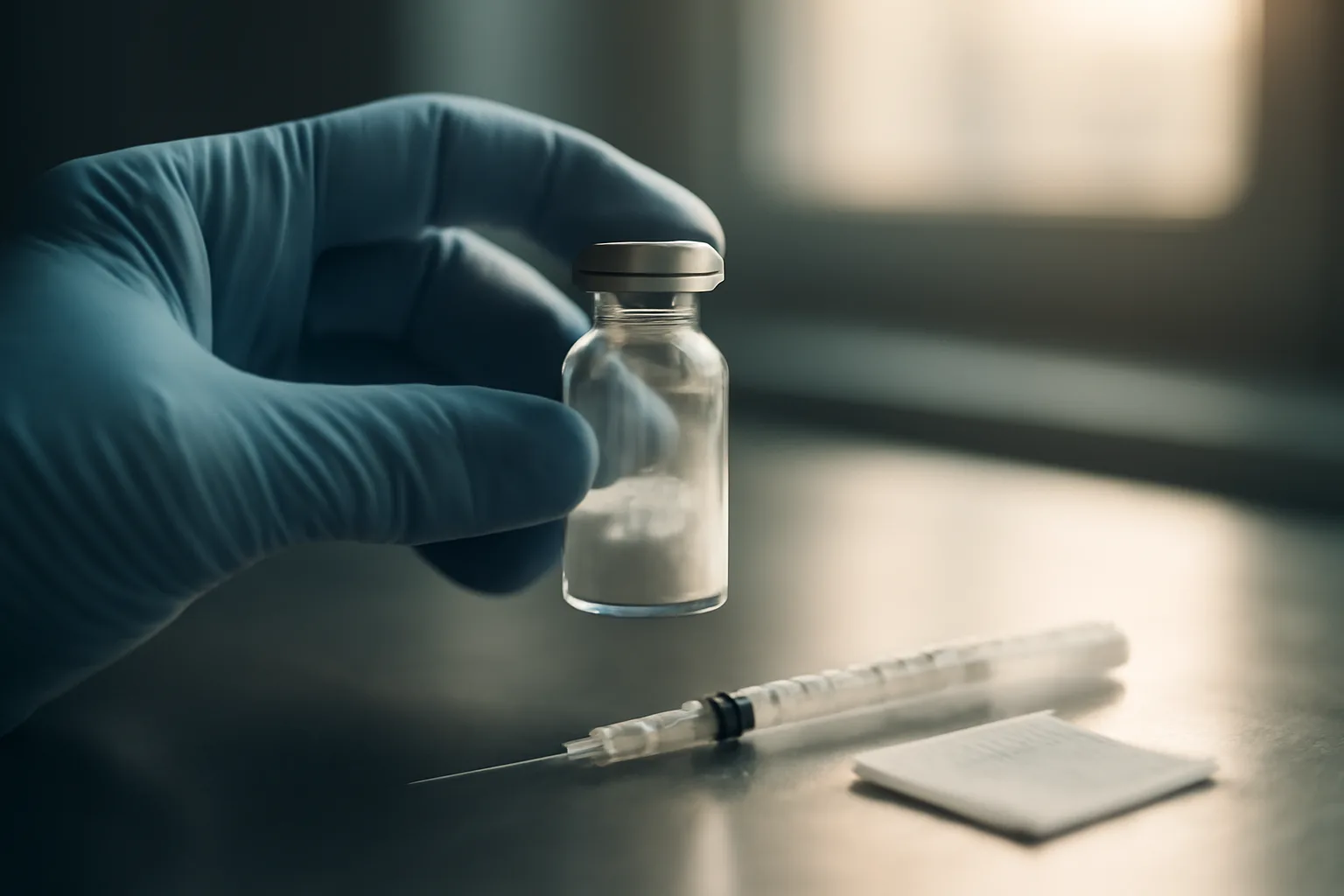
Because peptides don't announce themselves. A vial of bacteriostatic water and lactose filler looks identical to a vial with 2mg of correctly synthesized CJC-1295 in it. Both are white lyophilized powder, both dissolve clear, both sit in the same generic glass vial with a rubber stopper. Color, clarity, and reconstitution speed tell you almost nothing about identity or purity. A peptide that's 70% CJC-1295 and 30% degraded byproduct or truncated sequence will still look like a clean white cake and still dissolve into a clear solution. The failure mode you're worried about (wrong peptide, wrong dose, contamination, degradation) is chemically invisible at the level of human senses. This is why the entire verification question comes down to paperwork and lab data, not vibes. FDA guidance on compounding quality repeatedly points to analytical testing methods, not visual inspection, as the standard for confirming a compounded product's identity, strength, and purity [1]. There's no shortcut around that for a peptide bought outside a pharmacy relationship either.
what is a certificate of analysis and does it actually prove purity
A certificate of analysis (COA) is a lab report showing what a specific batch of material tested as, usually covering identity, purity percentage, and sometimes residual solvents or endotoxin levels. A real COA matters. A COA that isn't tied to your actual vial is close to worthless. The test that matters most is HPLC (high performance liquid chromatography), which separates a sample into its components and can show what percentage of the total material is the intended peptide versus degradation products or synthesis byproducts. Mass spectrometry confirms molecular identity, meaning it verifies the peptide is actually CJC-1295's sequence and not something else entirely, including a cheaper or inactive substitute. Here's the catch: a COA is a snapshot of one batch, tested at one point in time, usually at the manufacturer or an independent lab the manufacturer paid. It says nothing about: - Whether the vial in your hand came from that batch
- Whether storage and shipping conditions since testing were maintained
- Whether the lab itself is credible and more than printing whatever number the client wants A legitimate COA should include the lab name, the test method (HPLC-MS is the real standard), a batch or lot number that matches something printed on your vial, and a date. If a seller can't produce a document with all four of those, what you have is a marketing PDF, not a certificate of analysis.
what does the FDA actually say about compounded peptide quality
The FDA has been explicit that CJC-1295 is not an FDA-approved drug and has flagged bulk quality concerns publicly. FDA's 2023 nomination review memo for CJC-1295, prepared for the Pharmacy Compounding Advisory Committee, states that GHRH analogues in this class raise concern because they "may cause an unintended immune response" and that the nomination lacked adequate data to support a positive recommendation for the 503A bulks list [2]. That review is part of the agency's ongoing evaluation of substances nominated for use in compounding under section 503A of the Federal Food, Drug, and Cosmetic Act, the provision that governs when a bulk drug substance without an FDA-approved application can still be compounded by a pharmacy [3]. That's a regulatory judgment about the drug class generally, not a verdict on any specific vendor's manufacturing, but it matters context-wise: this is not a peptide with an established, FDA-inspected supply chain the way an approved prescription drug has. What this means practically: there is no FDA-approved reference standard for CJC-1295 that a lab can check your sample against the way it could for, say, insulin. Testing labs use reference standards from chemical suppliers or their own validated methods, which is a reasonable approach, but it underlines why the credibility of the specific testing lab matters so much.
how do research chemical vendors actually source and test CJC-1295
Most CJC-1295 sold as a "research chemical" comes from peptide synthesis manufacturers, overwhelmingly based in China, who sell in bulk to resellers who then repackage and relabel it. The manufacturing quality across that industry is genuinely inconsistent. Some manufacturers run real HPLC and mass spec quality control. Others don't, or they cut corners on later batches once they've built a reputation on early ones that were tested. The resale layer is where most of the risk concentrates. A reseller buying in bulk and splitting it into smaller vials for direct-to-consumer sale often has no independent testing relationship at all. They may forward the original manufacturer's COA (which may or may not correspond to the actual lot you're receiving) or they may have no COA to offer beyond a claim on their website. The honest baseline: assume any vendor selling loose vials with a generic label and no batch-specific, third-party COA has not verified what's in that vial, and neither can you. This is the gap that separates provider-reviewed sourcing routes, where a licensed pharmacy is involved in dispensing and stands behind product identity, from anonymous online sellers. If you want to understand what that alternative sourcing path looks like, cjc 1295 for sale covers how the provider-reviewed model differs from research-chemical resellers, and how to get cjc 1295 walks through the practical routes people use.
what red flags mean you should walk away from a CJC-1295 seller
Some signals are strong enough that no other reassurance from the seller should override them. No batch-specific COA, or a COA with no lot number that ties to the vial. If the document can't be matched to the physical product, it proves nothing about that product. Prices dramatically below the rest of the market. Peptide synthesis has a real cost floor. A 5mg vial of CJC-1295 selling for a fraction of what competitors charge for the same amount is a signal of cut corners somewhere, whether that's underdosing, filler, or skipped testing. Vague or copy-pasted COAs that appear on every product page regardless of peptide. If the same PDF format, font, and layout shows up for CJC-1295, ipamorelin, and BPC-157 alike, with only the peptide name swapped, that is a template, not a batch-specific test. No way to contact a real person, no return address, and no company registration information. Legitimate suppliers, even ones operating in the research chemical space, usually have some verifiable business presence. Claims of clinical or therapeutic benefit paired with consumer-style checkout. Language that promises fat loss, anti-aging results, or muscle gain outcomes while selling as a "research use only" product is a mismatch that regulators have flagged repeatedly; it signals a seller more interested in marketing than in the actual research-use framing that governs how this product is legally allowed to be sold in the US. Missing storage guidance. A seller who doesn't tell you the product needs refrigeration or protection from light either doesn't understand peptide stability or doesn't care. Real handling guidance is covered in CJC-1295 storage and shelf life.
does DAC vs no-DAC change how you verify quality
Yes, and this is one of the more common confusion points buyers run into. CJC-1295 comes in two distinct chemical forms and they are not interchangeable, so a COA or vendor claim needs to specify which one you're getting. CJC-1295 without DAC (sometimes sold under the name Mod GRF 1-29 or Sermorelin-adjacent naming, though these aren't strictly identical either) has a short half-life, on the order of 30 minutes, because it lacks the Drug Affinity Complex modification that binds to albumin in blood [4]. CJC-1295 with DAC has that modification and a dramatically longer half-life, reported around 6 to 8 days in the original pharmacokinetic study published in the Journal of Clinical Endocrinology & Metabolism [5]. These are different molecules with different molecular weights, different mass spec signatures, and different dosing logic entirely. A COA needs to specify which form was tested, and the molecular weight or mass spec peak location should match what's expected for that specific variant. If a vendor sells "CJC-1295" without ever clarifying DAC status, that's a labeling failure serious enough to be its own red flag, independent of purity concerns. For the full breakdown of how the two forms differ and which one shows up in which contexts, see cjc 1295 dac or no dac.
can you test CJC-1295 purity yourself at home
No, not meaningfully. There is no home test that identifies peptide purity or confirms sequence identity. Reagent test kits marketed for other research chemicals (colorimetric spot tests common in the psychedelic and stimulant testing space) don't have validated equivalents for peptides, because peptides don't produce the kind of simple color-change reaction those kits rely on. The only methods that actually confirm peptide identity and purity are laboratory-grade: HPLC for purity percentage, mass spectrometry for molecular identity, and sometimes amino acid analysis to confirm the actual sequence composition. These require instruments costing well into six figures and trained technicians to run and interpret. None of that is available to a consumer holding a vial at home. What you can do at home is behavioral, not analytical: check that the lyophilized powder looks like a clean, even cake (not a discolored or clumped mess), confirm the vial was shipped and stored cold if the vendor claims cold-chain shipping, and reconstitute using bacteriostatic water at room temperature, letting it sit rather than shaking it (shaking can denature the peptide and cause visible clouding, which is one of the only visual cues that's actually informative, per general peptide handling guidance from research suppliers). Clouding after gentle reconstitution is a bad sign. A clean, unclouded reconstitution is a neutral sign, not a good one; it just means nothing obviously went wrong, not that the peptide inside is what the label says. Full reconstitution mechanics are in cjc 1295 reconstitution.
how do you tell a legitimate CJC-1295 vendor from a bad one
Look at the whole picture, not one signal in isolation. A legitimate operation in this space typically has: a named, findable company (more than a storefront on a marketplace with no independent domain), COAs that are batch-specific with lot numbers matching vial labels, consistent pricing in line with the broader market (not an outlier low), clear research-use-only framing without therapeutic promise language, and responsive customer service that can answer specific questions about testing methodology without deflecting. The provider-reviewed model, where a licensed pharmacy is the entity actually dispensing the compounded product under a practitioner's oversight, is structurally different from the research-chemical reseller model. In that setup, the pharmacy carries its own regulatory accountability under state pharmacy board rules and, for 503A/503B facilities, FDA oversight frameworks, rather than a peptide reseller's self-reported COA being the only checkpoint. CJC-1295 Co reviews vendors against this kind of provider-reviewed standard and points readers toward routes where a named pharmacy is actually in the chain, rather than an anonymous drop-shipper. That's a meaningfully different risk profile than buying loose vials from a website with no traceable business behind it. None of this is a guarantee. Even licensed compounding pharmacies have had real quality failures, most infamously the 2012 New England Compounding Center meningitis outbreak tied to contaminated compounded steroid injections, which the CDC's outbreak investigation ultimately linked to 64 deaths among more than 750 confirmed cases across 20 states [6]. Licensure and oversight reduce risk; they don't eliminate it. But the gap between a licensed, inspected pharmacy and an anonymous online peptide reseller with a copy-pasted PDF is still enormous.
why is CJC-1295 usually paired with ipamorelin, and does that affect quality checks
CJC-1295 and ipamorelin are commonly stacked because they work through different receptor mechanisms that are thought to work well together. CJC-1295 is a GHRH analogue, meaning it mimics growth hormone releasing hormone and acts on the GHRH receptor in the pituitary. Ipamorelin is a ghrelin receptor agonist (a GH secretagogue in the same class as the older compound GHRP-6, but more selective), acting through a separate pathway. The rationale researchers cite is that stimulating both pathways together may produce a larger or more synchronized GH pulse than either compound alone, since they act on distinct receptors rather than competing for the same one. This combination has been studied in the context of GHRH/GHRP combined effects generally in growth hormone research, though it's worth being direct: there isn't a large body of published clinical trial data specifically on the CJC-1295-plus-ipamorelin combination's outcomes in humans. Most of what circulates about optimal ratios and expected effects comes from anecdotal forum reporting, not peer-reviewed trials, and treating that folklore as settled science overstates what's actually known. For verification purposes, buying the two peptides together doesn't change anything about how you'd check each one. Each should have its own batch-specific COA. A combined "CJC-1295/ipamorelin blend" vial actually raises the verification bar, not lowers it, because now you need confirmation of both the ratio between the two peptides and each one's individual purity, which is a more complex analytical question than testing a single peptide alone. If a vendor sells a pre-mixed blend with only one combined COA and no breakdown of individual component testing, treat that as a gap, not a convenience.
does third-party lab testing (like an outside COA) actually solve the trust problem
Partially, and only if the lab itself is credible and the chain of custody is clear. An independent third-party lab, meaning one with no financial relationship to the seller beyond a paid testing fee, is a real improvement over a manufacturer's self-reported COA. But "third-party" isn't a magic word. The relevant questions are: does the lab publish its accreditation (ISO 17025 is the standard reference for testing lab competence), does it disclose its testing method (HPLC-MS, more than "tested"), and can the batch number on the report be independently matched to a batch number physically printed on the vial you receive. Some sellers have started publishing links to third-party lab results on their sites, which is a genuine step forward for the industry. But a link to a report doesn't prove the report belongs to your vial unless the lot numbers line up. Buyers should ask sellers directly: which lot is this vial from, and can you send me the COA for that specific lot, more than a representative one. A seller unwilling or unable to answer that question specifically has told you something important.
what should you actually do before you buy or inject CJC-1295
Treat verification as a sequence of checks, not a single yes/no decision. First, confirm which form you're buying (DAC or no-DAC) and make sure the vendor's own labeling is unambiguous about it. Second, ask for a batch-specific COA with a lot number that matches the vial, run by HPLC-MS at a named lab. Third, check that the price sits within the normal market range rather than being a dramatic outlier. Fourth, check for a real, findable business behind the storefront. Fifth, consider whether a provider-reviewed pathway, where a licensed pharmacy is actually part of the supply chain, is available to you instead of an anonymous reseller. Once you've cleared those checks, the remaining questions are about handling, not identity: correct reconstitution technique (see cjc 1295 reconstitution), correct storage between doses (see CJC-1295 storage and shelf life), and correct injection technique and site rotation (see CJC-1295 injection sites). Quality verification and administration technique are separate problems, and getting the first one wrong makes the second one pointless.
Frequently asked questions
Can you tell if CJC-1295 is fake just by looking at the powder?
No. Real CJC-1295 and fake or degraded product both appear as white lyophilized powder that dissolves clear in bacteriostatic water. Visual inspection cannot detect wrong peptide identity, low purity, or filler substitution. Only lab methods like HPLC and mass spectrometry can confirm what's actually in the vial.
What is a COA and why does it matter for CJC-1295?
A certificate of analysis (COA) is a lab report on a specific manufacturing batch, showing purity percentage and identity confirmation, ideally via HPLC and mass spectrometry. It only means something if it includes a lot number matching your vial, a named testing lab, and a test date. A generic or unmatched COA proves nothing about the product you're holding.
Is CJC-1295 FDA approved?
No. CJC-1295 is not an FDA-approved drug. FDA's nomination review for the 503A bulks list flagged GHRH analogues in this class as a concern for potential unintended immune responses and noted insufficient data to support a positive compounding recommendation.
What's the difference between CJC-1295 with DAC and without DAC?
CJC-1295 without DAC has a short half-life of roughly 30 minutes. CJC-1295 with DAC includes a Drug Affinity Complex modification that binds albumin, extending its half-life to about 6 to 8 days according to the original pharmacokinetic study in the Journal of Clinical Endocrinology & Metabolism. They are different molecules requiring different dosing logic.
Can I test CJC-1295 purity myself at home?
No. There's no validated home test for peptide purity or identity. Reagent color-change kits used for other research chemicals don't have peptide equivalents. The only real methods are lab-based HPLC and mass spectrometry, which require equipment and expertise unavailable to consumers.
Why is CJC-1295 usually stacked with ipamorelin?
CJC-1295 acts on the GHRH receptor while ipamorelin acts on the ghrelin receptor, a separate pathway. The rationale is that combined stimulation may produce a larger GH pulse than either alone, but there isn't a large published clinical trial base specifically confirming outcomes from this combination in humans; much of what circulates is forum-level anecdote.
What are the biggest red flags when buying CJC-1295 online?
No batch-specific COA, prices far below market average, copy-pasted lab reports used across unrelated products, no verifiable business identity, therapeutic benefit claims paired with research-use-only labeling, and no storage or handling guidance. Any one of these alone is a caution; several together mean walk away.
Does a third-party lab test guarantee CJC-1295 is legitimate?
It helps but doesn't guarantee anything by itself. The lab needs real accreditation and a stated method (HPLC-MS), and the report's lot number must match the vial you actually received. A third-party report with no lot-matching is not meaningfully better than a manufacturer's own claim.
Is buying through a provider-reviewed pharmacy route safer than a research chemical reseller?
Generally yes, because a licensed compounding pharmacy carries regulatory accountability under state boards and FDA compounding frameworks that anonymous resellers don't have. It's not a zero-risk guarantee (compounding failures have happened even at licensed pharmacies), but the oversight layer is real and meaningfully different.
How much does legitimate CJC-1295 typically cost, and does price signal quality?
Prices vary by vendor and dose, but products priced dramatically below the rest of the market are a real warning sign, since peptide synthesis and testing have a genuine cost floor. Extremely cheap pricing usually means skipped testing, underdosed vials, or filler substitution somewhere in the chain.
What should reconstituted CJC-1295 look like?
It should dissolve into a clear, colorless solution without shaking, using bacteriostatic water at room temperature. Clouding after gentle reconstitution is a bad sign and suggests denaturation or contamination. A clean reconstitution is a neutral sign, not proof the peptide inside matches the label.
Does CJC-1295 need refrigeration, and does storage guidance signal a trustworthy seller?
Yes, lyophilized CJC-1295 should generally be stored refrigerated or frozen before reconstitution and refrigerated after, protected from light. A vendor who provides no storage or handling guidance either doesn't understand peptide stability or isn't being careful with customers, both of which are red flags.
Sources
- FDA, Guidance for Industry: Insanitary Conditions at Compounding Facilities (analytical testing standards referenced throughout compounding quality guidance): Analytical testing methods, not visual inspection, are the standard for confirming compounded drug identity, strength, and purity
- FDA, Center for Drug Evaluation and Research, Review of CJC-1295 nomination for the 503A Bulks List (memo to Pharmacy Compounding Advisory Committee): FDA staff flagged safety concerns for CJC-1295, citing potential for an unintended immune response and insufficient data to support a positive nomination
- 21 U.S.C. 353a, Federal Food, Drug, and Cosmetic Act Section 503A (Pharmacy Compounding): Section 503A of the Federal Food, Drug, and Cosmetic Act governs when a bulk drug substance without an FDA-approved application may be compounded by a pharmacy
- DrugBank Online, CJC-1295 entry (DB13732): CJC-1295 without DAC has a short elimination half-life
- Teichman SL, et al., Journal of Clinical Endocrinology & Metabolism, 2006, PMID 16352683: CJC-1295 with DAC produces sustained GH and IGF-1 elevation with a half-life of approximately 6 to 8 days
- CDC, Multistate Outbreak of Fungal Meningitis and Other Infections, Final Case Count (MMWR and outbreak summary): The 2012 New England Compounding Center contaminated injection outbreak was linked to 64 deaths among more than 750 confirmed cases across 20 states