Last updated 2026-07-26
TL;DR
CJC-1295 reconstitution means adding bacteriostatic water to lyophilized peptide powder to make an injectable solution. Use 2-3 mL per 2 mg vial as a common starting ratio, inject slowly down the vial wall, swirl gently, and refrigerate. Never shake the vial or use bacteriostatic water if you have a sulfa allergy without checking the preservative.
What does CJC-1295 reconstitution actually mean?
Reconstitution is just the process of turning a freeze-dried (lyophilized) peptide powder back into a liquid you can draw into a syringe. CJC-1295 ships as a sterile powder in a small glass vial because peptides in solution degrade much faster than peptides in powder form. Adding a liquid, almost always bacteriostatic water, dissolves the powder into a stable, injectable concentration. This isn't unique to CJC-1295. It's the same basic process used for insulin, HCG, and most other peptide and protein therapeutics that come as lyophilized powder. USP General Chapter <797> on pharmaceutical compounding for sterile preparations stresses that reconstitution has to happen under conditions that keep the vial sterile, because the powder itself has no preservative until you add bacteriostatic water [1]. The two things people get wrong most often: adding too much or too little liquid (throwing off dosing math) and being rough with the vial (shaking instead of swirling, which can damage the peptide's structure). Neither mistake is dangerous in the sense of causing acute harm, but both waste an expensive vial.
What do I need before I start?
You need five things: the lyophilized CJC-1295 vial, bacteriostatic water (not sterile water, not saline), alcohol swabs, a syringe with a fine gauge needle (commonly 29-31G for the injection itself, plus a larger draw needle if the kit includes one), and a clean flat surface. Bacteriostatic water contains 0.9% benzyl alcohol as a preservative, which is what lets a reconstituted vial last for weeks in the fridge instead of hours. Sterile water without a preservative is meant for single, immediate use and isn't the right choice for a multi-dose peptide vial. The Hospira prescribing information for Bacteriostatic Water for Injection, USP describes the product as water "preserved with 0.9% benzyl alcohol" intended for use as a diluent for parenteral drugs [2]. One real caveat: benzyl alcohol preservative is generally avoided in neonates due to historical toxicity reports in that population, which is why single-use sterile water is preferred for newborns in clinical settings [2]. That has nothing to do with adult peptide use, but it's the reason bacteriostatic water carries that warning on the label, and it's worth knowing so you don't panic when you read the package insert.
How much bacteriostatic water should I add to CJC-1295?
| 2 mg | 2 mL | 1,000 mcg/mL (1 mg/mL) | 10 units (0.1 mL) | |
|---|---|---|---|---|
| 2 mg | 1 mL | 2,000 mcg/mL (2 mg/mL) | 5 units (0.05 mL) | |
| 5 mg | 2 mL | 2,500 mcg/mL | 4 units (0.04 mL) | |
| 5 mg | 5 mL | 1,000 mcg/mL | 10 units (0.1 mL) | More water means a more dilute solution, which means larger, easier-to-measure injection volumes, but it also means the vial runs out sooner if you're pulling more liquid per dose. Less water concentrates the dose into a smaller volume, which stretches the vial further but makes small-unit measurement errors matter more. Most people land on the 1 mg/mL setup because it maps cleanly onto standard insulin syringe markings (a U-100 syringe's 100-unit scale equals 1 mL). If you're unsure of your vial's exact peptide mass, don't guess. Check the label or the certificate of analysis from the supplier, because reconstitution math is only as good as the number you start with. |
There's no single official ratio because CJC-1295 isn't an FDA-approved drug with a package insert dosing table. What exists is a practical range that most reconstitution guides and compounding pharmacies converge on: roughly 2 mL of bacteriostatic water for a 2 mg vial gives you 1 mg/mL, and that concentration is easy to dose accurately with an insulin syringe marked in units. Here's the math broken out: | Vial size | BAC water added | Resulting concentration | 100 mcg dose = |
What's the actual step-by-step reconstitution process?
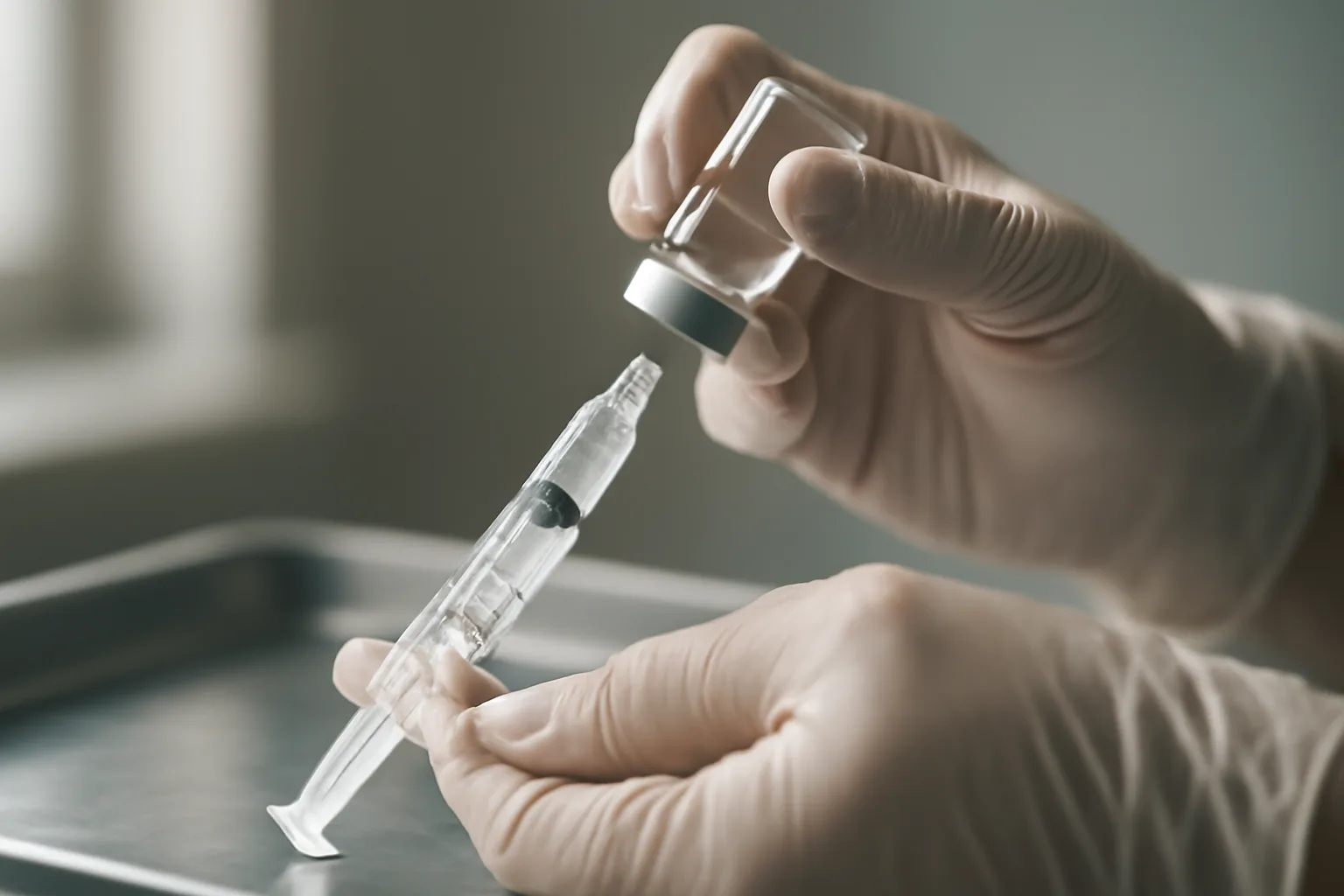
Wipe the top of the vial and the top of the bacteriostatic water vial with an alcohol swab and let them air dry for a few seconds. Draw the bacteriostatic water into your syringe to the volume you calculated (2 mL for a 2 mg vial at 1 mg/mL, for example). Insert the needle into the CJC-1295 vial at an angle, so the water runs down the inside glass wall rather than blasting straight onto the powder. This is the single most important technique detail. A direct stream can shear the peptide and cause excess foaming. Once the water is in, don't shake. Roll the vial gently between your palms or swirl it in slow circles until the powder is fully dissolved, which usually takes under a minute. The solution should look clear, not cloudy and not foamy. Let it sit for a minute or two if there's any residual foam, then label the vial with the date and concentration immediately. This last step sounds trivial and it's the one people skip, and then three weeks later nobody remembers if the vial is 1 mg/mL or 2 mg/mL.
Can I use sterile water or saline instead of bacteriostatic water?
Technically the peptide will dissolve in sterile water or saline too, but neither has a preservative, so the reconstituted solution has a drastically shorter usable window and higher contamination risk with repeated needle entries. Bacteriostatic water's benzyl alcohol content is specifically what allows a vial to be punctured multiple times over days or weeks without becoming a bacterial culture. If your only option is preservative-free sterile water, treat that vial as single-use and discard leftovers rather than storing it for repeat draws. This mirrors general USP guidance on multi-dose versus single-dose sterile containers [1]. It's not the setup most people want for a peptide they're dosing daily for months.
How should I store CJC-1295 after reconstitution?
Refrigerate it, don't freeze it, and keep it out of light. Reconstituted peptide solutions are generally kept at 2-8°C (36-46°F), the same range used for most reconstituted biologics and vaccines per CDC vaccine storage guidance, which is the closest real-world analog for how a refrigerated peptide solution should be handled [3]. Most reconstitution guides suggest using a reconstituted CJC-1295 vial within 20 to 30 days for best stability, though there's no peer-reviewed stability study specifically tracking CJC-1295 degradation curves in bacteriostatic water at 4°C, so treat that window as a practical convention rather than a hard scientific cutoff. If the solution turns cloudy, changes color, or develops visible particles, discard it regardless of how many days have passed. For a full breakdown of shelf life before and after mixing, freeze-thaw effects, and how vial storage compares to lyophilized storage, see CJC-1295 storage and shelf life.
Does CJC-1295 with DAC reconstitute differently than without DAC?
The reconstitution mechanics are identical, but the reason people choose one form over the other changes what the vial is used for, which indirectly affects concentration choices. CJC-1295 without DAC (sometimes labeled CJC-1295 no-DAC or sold under the name Mod GRF 1-29) is a shorter-acting GHRH analogue with a half-life of roughly 30 minutes, meant for once or multiple-times-daily dosing timed around pulses of GH release. CJC-1295 with DAC (Drug Affinity Complex) is chemically modified to bind serum albumin, which extends its half-life to several days, cited in the original pharmacology literature as supporting less frequent dosing [4]. Because no-DAC is dosed more frequently and often paired with a GHRP like ipamorelin in the same session, people commonly reconstitute it to a concentration that gives convenient small-volume daily doses (1 mg/mL is typical). DAC, dosed weekly or twice weekly in most protocols, gets reconstituted the same way but the total mcg per injection is usually higher per pull, so some people use a slightly more concentrated mix to keep injection volume reasonable. Neither form has an FDA-approved dosing label, so all of these ratios are convention, not regulation. For the deeper mechanistic comparison, read CJC-1295 DAC or no-DAC.
Why is CJC-1295 usually paired with ipamorelin, and does that change reconstitution?
The pairing logic is mechanistic: CJC-1295 is a GHRH analogue that increases the amplitude of natural GH pulses, while ipamorelin is a ghrelin-receptor agonist (a GHRP) that works through a separate pathway to also stimulate GH release with minimal effect on cortisol or prolactin compared to older GHRPs [5]. Combining a GHRH analogue with a GHRP is a well-studied class of stacking in the endocrinology literature going back decades, on the logic that hitting two distinct receptor pathways produces a larger GH pulse than either alone. That's the mechanistic rationale. It is not the same as a completed human trial showing that CJC-1295 plus ipamorelin outperforms either compound alone on a specific clinical endpoint like lean mass or fracture risk. Treat the combination as biologically plausible and mechanistically supported, not as a settled outcome. On reconstitution specifically: ipamorelin and CJC-1295 are reconstituted separately, in their own vials, using the same bacteriostatic water technique described above. Some people draw both into the same syringe immediately before injecting once both are dissolved (this is fine short-term), but they should not be mixed and stored together in one vial long-term, since stability data for a combined solution doesn't really exist.
What if the powder won't fully dissolve or the vial looks cloudy?
A little residual foam right after mixing is normal and usually clears within a couple of minutes of sitting undisturbed. Persistent cloudiness, visible clumps, or a solution that stays hazy after several minutes is not normal and suggests either a bad reconstitution technique (water hit the powder too hard) or a compromised vial. If a vial looks off, the safe move is to not inject it. This isn't a case where you eyeball it and hope. Discard and use a fresh vial. This is one of the clearest, cheapest quality checks you have, and it costs nothing but the vial itself.
How do I know I'm getting real, correctly dosed CJC-1295 to reconstitute in the first place?
Reconstitution technique doesn't fix an underlying sourcing problem. If the vial doesn't actually contain 2 mg of CJC-1295, your careful math on bacteriostatic water ratios is calculating a dose of the wrong thing. Research has repeatedly found that peptides sold outside legitimate pharmacy channels are inconsistently dosed or mislabeled; this is a known issue across the broader research-chemical peptide market and not something reconstitution technique can correct for. CJC-1295 isn't FDA-approved for any indication, so it's not sold in retail pharmacies with an approved label the way, say, insulin is [6]. That reality is exactly why sourcing matters as much as mixing technique. See CJC-1295 for sale for how to evaluate sourcing, and how to get CJC-1295 for the provider-reviewed route: a legitimate compounding pathway that starts with a clinician review rather than an anonymous online cart. CJC-1295 Co's own listings point toward that provider-reviewed route, fulfilled through a named compounding pharmacy partner, specifically because vial-to-vial consistency is the part bodybuilding forums can't verify for you.
What injection details matter after reconstitution is done?
Once the vial is mixed, draw your calculated dose with a fresh needle each time and inject subcutaneously, rotating sites to avoid irritation at any one spot. Common injection sites are the abdomen and the front of the thigh, similar to how other subcutaneous peptides and insulin are dosed. For the full rundown of site rotation, needle gauge choice, and technique to avoid lumps or bruising, see CJC-1295 injection sites. And if the broader safety profile, including realistic side effects and who should avoid GH secretagogues entirely, is what you're after, that's covered in is CJC-1295 safe.
Frequently asked questions
How much bacteriostatic water do I add to a 5 mg CJC-1295 vial?
A common approach is 2 mL for a more concentrated 2,500 mcg/mL solution or 5 mL for a 1,000 mcg/mL solution that maps cleanly onto insulin syringe unit markings. There's no official ratio since CJC-1295 has no FDA-approved label; both are workable conventions, and the choice mostly affects injection volume and how long the vial lasts.
Can I reconstitute CJC-1295 with normal tap or bottled water?
No. Only bacteriostatic water (or sterile water for single, immediate use) should touch a peptide vial. Tap and bottled water aren't sterile and introduce contamination risk plus mineral content that can interact with the peptide. Bacteriostatic water for injection is an FDA-labeled product preserved with 0.9% benzyl alcohol specifically for this purpose.
How long does reconstituted CJC-1295 last in the fridge?
Most practical guides suggest 20 to 30 days when refrigerated at 2-8°C and protected from light, though no published stability study has tracked CJC-1295 degradation specifically in bacteriostatic water over time. Discard immediately if the solution turns cloudy, changes color, or shows particles, regardless of how many days have passed.
Do I shake or swirl the vial after adding bacteriostatic water?
Swirl gently or roll the vial between your palms. Never shake it. Shaking introduces excess air, causes foaming, and can physically shear the peptide's structure, degrading it before you ever inject it. Directing the water down the vial's inside wall rather than straight onto the powder also reduces foaming from the start.
Is CJC-1295 with DAC reconstituted differently than CJC-1295 no-DAC?
The mixing process is identical for both. The difference is dosing frequency: no-DAC has a roughly 30-minute half-life and is typically dosed daily, while DAC binds serum albumin and is dosed weekly or twice weekly. That frequency difference, not the reconstitution method, is what drives people toward different concentration choices for each form.
Can I mix CJC-1295 and ipamorelin in the same vial?
They should be reconstituted separately in their own vials with their own bacteriostatic water. Drawing both into one syringe immediately before injecting is common practice, but storing them combined in a single vial long-term isn't recommended, since there's no stability data on how the mixed solution holds up over days or weeks.
What syringe size should I use to reconstitute and inject CJC-1295?
A 1 mL (100-unit) insulin syringe with a fine needle, commonly 29-31 gauge, is standard for both drawing the bacteriostatic water into the vial and for the subcutaneous injection itself. Some kits include a separate, larger-gauge needle just for the reconstitution draw, then a fine needle is swapped in for injecting.
Why is my reconstituted CJC-1295 vial cloudy or foamy?
Mild foam right after mixing is normal and usually clears within a couple of minutes if the vial sits undisturbed. Persistent cloudiness or clumping after that suggests the water hit the powder too forcefully during reconstitution, or the vial itself was compromised. Don't inject a cloudy or persistently foamy solution; discard it and use a fresh vial.
Does bacteriostatic water expire once opened?
Yes. Manufacturer labeling for bacteriostatic water for injection generally supports use within about 28 days after first puncture, similar to other multi-dose preserved diluents, though you should check the specific product's insert. Store it at room temperature away from light and discard if it looks cloudy or discolored.
Can I reuse the same needle to reconstitute and then inject?
It's better to use a separate needle for each step if your kit provides one, since the reconstitution needle (often larger gauge) can dull slightly after piercing two rubber stoppers, making the injection needle for your skin less sharp than ideal. At minimum, always use a fresh, sterile needle for the actual injection into skin.
Is there an FDA-approved dosing standard for CJC-1295 reconstitution?
No. CJC-1295 isn't an FDA-approved drug, so there's no approved package insert with an official reconstitution ratio the way there is for drugs like insulin or HCG. The ratios described in this guide (roughly 1-2 mg/mL) are practical conventions drawn from compounding norms for similar peptides, not regulatory requirements.
What happens if I add the wrong amount of bacteriostatic water?
Adding more water than planned dilutes the solution, so each unit on your syringe delivers less peptide than intended. Adding less water concentrates it, so the same unit measurement delivers more. Neither mistake is dangerous by itself, but it throws off your dosing math; recalculate your draw volume based on the actual water amount used, or start over with a fresh vial if unsure.
Sources
- USP General Chapter <797> Pharmaceutical Compounding, Sterile Preparations (via U.S. Pharmacopeia): Sterile compounding and multi-dose vial handling standards for reconstituted preparations
- Hospira, Bacteriostatic Water for Injection, USP, prescribing information (DailyMed): Bacteriostatic water is preserved with 0.9% benzyl alcohol and carries a warning against use in neonates
- CDC, Vaccine Storage and Handling Toolkit: Refrigerated biologic solutions are generally stored at 2-8°C (36-46°F)
- Teichman SL et al., Journal of Clinical Endocrinology & Metabolism (2006), PMID 16352683: CJC-1295 with DAC has an extended half-life supporting less frequent dosing compared to unmodified GHRH analogues
- Raun K et al., European Journal of Endocrinology (1998), PMID 9856419: Ipamorelin acts as a selective GH secretagogue with minimal effect on cortisol and prolactin compared to older GHRPs
- FDA, Compounding and the FDA: Questions and Answers: CJC-1295 is not an FDA-approved drug and is not sold under an approved retail pharmacy label