Last updated 2026-07-26
TL;DR
CJC-1295 without DAC is typically dosed at 100 mcg, 1-3 times daily, mimicking GHRH pulses. CJC-1295 with DAC, the long-acting version, is dosed around 1-2 mg once weekly or split into 2 doses because its half-life runs 6-8 days. Neither dose is FDA-approved; these figures come from research and compounding literature, not labeled human clinical guidance.
What is CJC-1295 and how does its dosage differ from other peptides?
CJC-1295 is a synthetic analogue of growth hormone releasing hormone (GHRH), built to stimulate the pituitary gland to release more growth hormone. It comes in two forms that get dosed completely differently, and mixing them up is the single most common mistake people make when reading a "CJC-1295 dosage chart" online. The first form, often just called CJC-1295 or CJC-1295 without DAC (also sold as Mod GRF 1-29), has a short half-life of roughly 30 minutes [1]. It behaves like a natural GHRH pulse, so it needs to be dosed multiple times a day to keep matching the body's own release pattern. The second form, CJC-1295 with DAC (Drug Affinity Complex), is chemically modified to bind to albumin in the blood. That binding stretches its half-life out to about 6 to 8 days in humans, based on the original pharmacokinetic study published in the Journal of Clinical Endocrinology & Metabolism [2]. One injection can keep GH and IGF-1 elevated for over a week. Because the two forms have such different clearance rates, dosage charts that don't specify DAC status are close to useless. Always check which version a source is talking about before you look at a number. For a side-by-side breakdown of how these two forms compare on onset, duration, and use case, see cjc 1295 dac vs no dac.
What is the standard CJC-1295 dosage without DAC?
CJC-1295 without DAC is generally used at 100 mcg per injection, given 1 to 3 times per day. This mirrors the dosing pattern used in GHRH research going back decades, where short-acting GHRH analogues were given multiple times daily to produce pulsatile GH release rather than a flat, sustained elevation [3]. A common research protocol looks like this: 100 mcg first thing in the morning on an empty stomach, another 100 mcg pre-workout, and a third 100 mcg dose before bed. Some protocols use only the bedtime dose, since natural GH pulses are largest during the first few hours of deep sleep [4]. There is no FDA-approved dosing schedule for CJC-1295 in humans. Every number circulating online, including the ones above, comes from compounding pharmacy references, animal studies, or extrapolation from related GHRH research, not from a labeled drug insert. Treat these as commonly cited starting points, not medical instructions. Multiple daily injections is the tradeoff for choosing the non-DAC version. If that schedule is unrealistic for you, that's the practical case for DAC, not because no-DAC is inferior on paper, but because compliance matters more than theoretical peak GH pulses.
What is the CJC-1295 DAC dosage per week?
| CJC-1295 no DAC | 100 mcg | 1-3x per day | 700 mcg - 2.1 mg | |
|---|---|---|---|---|
| CJC-1295 with DAC | 1-2 mg | 1x per week (or split 2x) | 1-2 mg | |
| CJC-1295 with DAC (higher-end research dose) | up to ~4-5 mg (60 mcg/kg in an 80kg adult) | single dose | studied acutely, not typical for repeat weekly use in current protocols [2] | For a calculator that walks through mg-per-kg math and reconstitution volume, see the cjc-1295 dac dosage calculator. |
CJC-1295 with DAC is typically dosed at 1 to 2 mg per week total, most often given as a single weekly injection or split into two smaller doses of 0.5 to 1 mg roughly 3 to 4 days apart. Because of its long half-life, splitting the weekly total doesn't meaningfully change peak GH output, it just smooths out the blood concentration curve slightly. The original human pharmacokinetic and pharmacodynamic study on CJC-1295 with DAC tested single doses ranging from 30 mcg/kg up to 60 mcg/kg and 100 mcg/kg, and found that a single injection could increase GH levels for 6 or more days, with IGF-1 levels staying elevated for up to 9 to 11 days after a single dose depending on dose level [2]. For a person around 80 kg, a 60 mcg/kg dose would land near 4.8 mg, well above what most current protocols use. That tells you commonly circulated "2 mg/week" dosing is conservative compared to what was actually tested in that trial, not an exact replica of it. Here is a rough comparison table people search for as a "cjc-1295 dosage chart": | Form | Typical single dose | Frequency | Approx. weekly total |
How much CJC-1295 DAC should I take per day if I'm not doing weekly dosing?
If someone wants to convert a weekly DAC total into a daily-equivalent figure, dividing a 1-2 mg weekly dose across 7 days works out to roughly 140-285 mcg per day. But this framing is somewhat artificial: the entire pharmacological rationale for choosing the DAC version is that you don't need daily dosing, since its extended half-life is doing the job that repeated daily injections do for the non-DAC version. If your actual goal is a daily-dosing schedule, the non-DAC (Mod GRF 1-29) form is the more logical fit, not DAC dosed daily at a fraction of its weekly total. Using DAC on a daily schedule at low microgram doses hasn't been studied in the pharmacokinetic literature the way weekly or twice-weekly dosing has [2], so anyone doing this is working from forum extrapolation rather than trial data.
How is CJC-1295 typically prepared and injected?
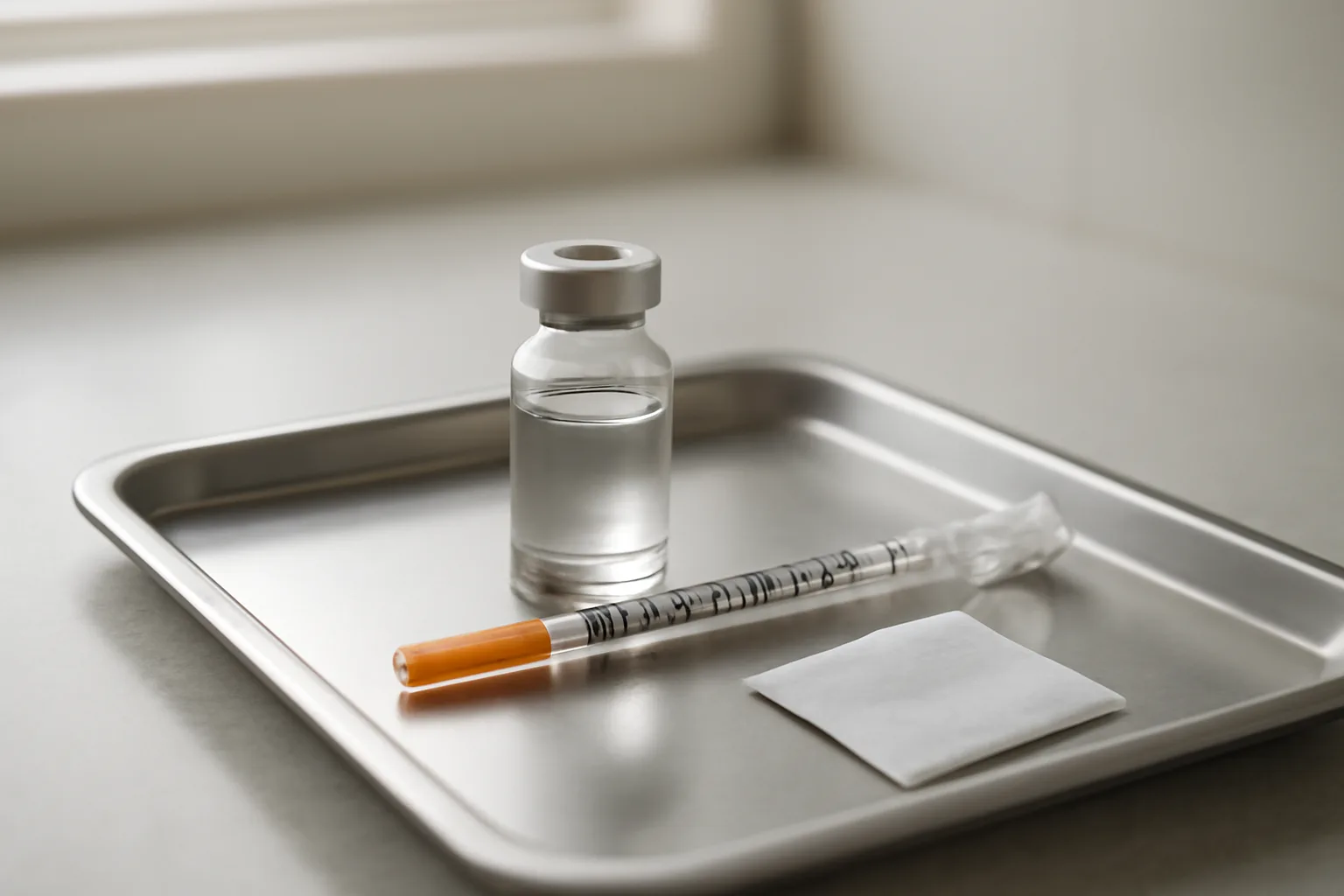
CJC-1295 is supplied as a lyophilized (freeze-dried) powder that needs to be reconstituted with bacteriostatic water before injection. Standard practice in compounding and research contexts is subcutaneous injection into the abdomen or thigh, using an insulin syringe marked in units (where 100 units = 1 mL). Reconstitution volume determines concentration, and getting this math wrong is the single most common dosing error. As an example: a 2 mg vial reconstituted with 2 mL of bacteriostatic water yields 1 mg/mL, or 1,000 mcg/mL. A 100 mcg dose would then be 0.1 mL, or 10 units on an insulin syringe. If someone reconstitutes with a different volume, every subsequent unit-to-mcg conversion changes, so the vial's actual peptide content and the diluent volume used both need to be tracked, more than the syringe reading. Bacteriostatic water containing benzyl alcohol as a preservative allows a reconstituted vial to be used over multiple injections when refrigerated, generally cited as being stable for up to 20-30 days by peptide compounding references, though there's no FDA-set stability standard specific to CJC-1295 and actual degradation depends heavily on storage temperature and handling.
Why is CJC-1295 usually paired with ipamorelin, and does that change dosage?
CJC-1295 and ipamorelin are commonly stacked because they act on two different receptor pathways that both drive GH release: CJC-1295 mimics GHRH, while ipamorelin is a ghrelin-receptor agonist (a growth hormone secretagogue, GHS) [3]. The theoretical rationale is that GHRH analogues increase the amplitude of GH pulses while ghrelin-mimetics increase the number of somatotroph cells releasing GH and blunt somatostatin's inhibitory tone, so combining the two mechanisms could produce more GH release than either alone. That mechanistic logic is well established in endocrinology for GHRH and GHS classes generally [3], but it's worth being direct: there is no large, published clinical trial demonstrating that the CJC-1295 plus ipamorelin combination in humans produces superior long-term outcomes (body composition, strength, sleep quality) compared to either peptide alone. Most of what circulates about the combo's real-world effects comes from anecdote and bodybuilding forum protocols, not peer-reviewed data. That doesn't mean the mechanism is wrong, just that the specific claims of combined benefit haven't been through controlled human trials the way the individual pharmacokinetics have. Dosage-wise, stacking doesn't typically change the CJC-1295 number. A common paired protocol is 100 mcg CJC-1295 (no DAC) with 100-200 mcg ipamorelin, injected together subcutaneously, 1-3 times daily. If using CJC-1295 with DAC instead, the weekly DAC dose stays the same while ipamorelin is still usually dosed daily, since ipamorelin's own half-life is short (around 2 hours) [5]. More detail on the underlying mechanism is in the main cjc 1295 overview.
What factors should change my CJC-1295 dose?
Body weight is the main variable studied directly: the 2006 human trial dosed CJC-1295 with DAC on a mcg/kg basis (30, 60, and 100 mcg/kg), which means a 60 kg adult and a 100 kg adult were given meaningfully different total doses to hit the same relative exposure [2]. Flat "2 mg for everyone" protocols popular online ignore this and default to a rough average that may under- or over-dose people at either end of typical adult body weight. Goal also matters in how protocols are framed, though again, most of these framings come from user-reported practice rather than trials specifically comparing dose-by-goal outcomes. People using it for general anti-aging or sleep-quality goals often gravitate toward lower, less frequent DAC dosing (around 1 mg/week). People pursuing more aggressive body composition changes often report using higher or more frequent dosing, sometimes combining daily no-DAC dosing with periodic higher DAC doses. None of this higher-dose bodybuilding-forum territory is supported by controlled trial data on optimal dose for those specific outcomes. Kidney and liver function matter because GH and IGF-1 are cleared renally and hepatically, and no dedicated dose-adjustment studies exist for CJC-1295 in people with impaired organ function. That's one of several reasons this compound sits outside standard medical dosing guidance and firmly in the off-label, largely self-directed use category.
How long does a typical CJC-1295 cycle or protocol run?
Protocols commonly cited in compounding and peptide literature run 8 to 12 weeks, sometimes followed by a break of 4 to 8 weeks before resuming, based on the general principle in GH secretagogue research that pituitary responsiveness and IGF-1 elevation patterns should be periodically reassessed rather than run indefinitely without monitoring [3] [4]. This isn't a regulatory requirement, since there's no FDA labeling for CJC-1295 dictating cycle length; it's a convention borrowed from broader peptide and hormone practice. The honest caveat here: there's no dedicated long-term human safety trial establishing what happens with continuous, uninterrupted CJC-1295 with DAC use over many months or years. The 2006 pharmacokinetic study followed single and limited repeat dosing, not indefinite chronic administration [2]. Anyone running long or repeated cycles is doing so without a clinical trial mapping that territory, which is a real gap, more than a formality.
What are the safety signals to watch for at these dosages?
IGF-1 elevation is the main lab marker used to gauge whether a dose is doing anything physiologically, and it's also the main long-term safety concern, since chronically elevated IGF-1 is linked in the broader endocrine literature to increased risk of insulin resistance and, in some population studies, certain cancers, which is why GH-axis drugs generally carry monitoring guidance in clinical use [6]. Injection site reactions (redness, welting, mild swelling) are the most commonly reported side effect in compounding pharmacy adverse event reporting for peptides in this class, generally described as mild and self-limited. Water retention, joint stiffness, and headache are also frequently self-reported at higher doses, consistent with GH-axis activation generally. For a full rundown of documented and theoretical side effects by dose range, see cjc 1295 side effects.
Is CJC-1295 legal to buy and does dosage regulation exist?
CJC-1295 is not FDA-approved for any human medical use and has no established prescribing label or dosage guidance from the FDA [7]. It is available through compounding pharmacies and research chemical suppliers, and the FDA has specifically flagged CJC-1295 as a substance that should not be used in compounding under section 503A or 503B because it does not meet the statutory criteria (bulk drug substance nominated but not placed on FDA's approved bulk substances lists for compounding, and it has safety concerns raised in the agency's own review) [7]. This matters directly for dosing conversations: there is no FDA-set safe or effective dose because the agency has not approved a dose-response profile for this compound in a marketed product. Every dosage figure discussed anywhere, including this article, is derived from an early-phase pharmacokinetic study, animal research, or accumulated compounding and off-label practice, not an approved drug label. If you're sourcing CJC-1295, working with a provider-reviewed pathway that discloses testing and pharmacy fulfillment matters more here than with a typical supplement, given the regulatory gap. cjc 1295 for sale covers what to check before buying, and CJC-1295 Co reviews sourcing routes and points readers toward the pharmacy partner actually fulfilling and testing product, rather than compounding or selling anything directly.
How does CJC-1295 dosage compare to other GH secretagogues like sermorelin or tesamorelin?
Sermorelin, an earlier GHRH analogue, is typically dosed at 200-300 mcg subcutaneously once daily at bedtime in the off-label and compounding literature, closer to CJC-1295 without DAC in dosing frequency because it also has a short half-life [8]. Tesamorelin, which is FDA-approved specifically for HIV-associated lipodystrophy under the brand Egrifta, has an actual labeled dose: 2 mg subcutaneously once daily, per its FDA label, making it the one compound in this class with real regulatory dosage backing [9]. That contrast is worth sitting with. Tesamorelin has a specific, tested, FDA-labeled 2 mg daily dose for a specific approved condition. CJC-1295, in either form, has none of that; it operates entirely in the off-label and research space, and its dosing figures are extrapolated, not label-derived.
Frequently asked questions
What is the standard CJC-1295 dosage for beginners?
Most protocols for beginners use CJC-1295 without DAC at 100 mcg once daily, usually at bedtime, before adding a second or third daily dose. For DAC, a beginner-level protocol is typically 1 mg once weekly. Neither figure is FDA-set; they're common conservative starting points drawn from compounding practice, not clinical dosing standards.
What is the difference between CJC-1295 with DAC and without DAC dosing?
No-DAC CJC-1295 has a roughly 30-minute half-life and is dosed multiple times daily (commonly 100 mcg, 1-3x/day). DAC-bound CJC-1295 has a 6-8 day half-life, per the original human PK study, and is dosed weekly, usually 1-2 mg once or split into two doses [2].
How many mcg of CJC-1295 should I take per day?
For CJC-1295 without DAC, 100 mcg per injection, 1 to 3 times per day, is the most commonly cited protocol. For DAC, daily microgram framing doesn't fit its pharmacology well; it's dosed weekly, not daily, since its extended half-life is the entire point of using it.
How much CJC-1295 DAC should I inject per week total?
Most current protocols use 1 to 2 mg per week, either as one injection or split into two doses roughly 3-4 days apart. The original pharmacokinetic trial tested higher acute doses (30-100 mcg/kg), which is well above what typical weekly protocols use today [2].
Can I take CJC-1295 and ipamorelin at the same time?
Yes, they're commonly injected together since they act on different receptors (GHRH vs ghrelin receptor). This is a widely used combination based on sound mechanistic reasoning, but no major clinical trial has confirmed superior outcomes from the combo over either peptide alone in humans [5][6].
How do I calculate my CJC-1295 dosage from a vial?
Divide total mg in the vial by mL of bacteriostatic water used to get concentration (mg/mL), then convert to mcg/mL by multiplying by 1,000. A 2 mg vial in 2 mL water gives 1,000 mcg/mL; a 100 mcg dose is 0.1 mL, or 10 units on an insulin syringe.
Is there an FDA-approved CJC-1295 dosage?
No. The FDA has not approved CJC-1295 for any use and has flagged it as unsuitable for compounding under sections 503A/503B [8]. All dosing figures in circulation come from early-phase research, compounding references, or off-label practice, not an approved label.
How long should a CJC-1295 cycle last?
Commonly cited protocols run 8 to 12 weeks followed by a 4-8 week break, a convention borrowed from broader GH secretagogue practice rather than a rule tested specifically for CJC-1295 in long-term human trials.
Does body weight affect CJC-1295 dosage?
Yes, at least in the original human trial, which dosed CJC-1295 with DAC on a mcg/kg basis (30, 60, and 100 mcg/kg) [2]. Flat weekly mg protocols used today ignore this scaling and apply roughly the same dose regardless of body weight.
What happens if I take too much CJC-1295?
Likely effects at high doses include water retention, joint or muscle stiffness, headache, flushing, and injection site reactions, consistent with excess GH-axis activation. There's no established human toxic dose threshold published for CJC-1295 specifically, since it hasn't gone through full clinical dose-ranging trials.
How is CJC-1295 injected, subcutaneous or intramuscular?
Subcutaneous injection into the abdomen or thigh using an insulin syringe is the standard method described in compounding and peptide-use literature, not intramuscular. This is consistent with how similar small peptide hormones are typically administered off-label.
Is CJC-1295 dosage the same as tesamorelin dosage?
No. Tesamorelin has an FDA-approved label dose of 2 mg subcutaneously once daily for HIV-associated lipodystrophy [10]. CJC-1295 has no FDA-approved dose for any condition; its figures come from a single pharmacokinetic study and off-label practice.
Sources
- National Center for Biotechnology Information, PubChem: CJC-1295 (no DAC / Mod GRF 1-29) summary: CJC-1295 without DAC has a short half-life of approximately 30 minutes
- Teichman SL, et al., Journal of Clinical Endocrinology & Metabolism, 2006: Single-dose human PK/PD study of CJC-1295 with DAC showing 6-8 day half-life and sustained GH/IGF-1 elevation across 30-100 mcg/kg doses
- Sigalos JT, Pastuszak AW, Sexual Medicine Reviews, 2018: GHRH analogues are studied for pulsatile GH release patterns and multi-dose-per-day regimens
- Van Cauter E, et al., Endocrine Reviews / sleep-GH literature: Natural GH pulses are largest during early slow-wave sleep, informing bedtime dosing rationale
- Raun K, et al., European Journal of Endocrinology, 1998: Ipamorelin pharmacology and short half-life characterization
- Endocrine Society, Clinical Practice Guideline on Growth Hormone Deficiency: IGF-1 monitoring is standard practice in GH-axis therapies due to metabolic and safety concerns of chronic elevation
- U.S. Food & Drug Administration, 503A Bulks List Nominations and Category assessments: CJC-1295 is not FDA-approved and has been evaluated and flagged regarding compounding suitability under 503A/503B
- National Center for Biotechnology Information, PubChem: Sermorelin: Sermorelin off-label dosing typically cited at 200-300 mcg once daily
- FDA-approved label, Egrifta (tesamorelin), accessdata.fda.gov: Tesamorelin (Egrifta) FDA-approved labeled dose is 2 mg subcutaneously once daily for HIV-associated lipodystrophy