Last updated 2026-07-26
TL;DR
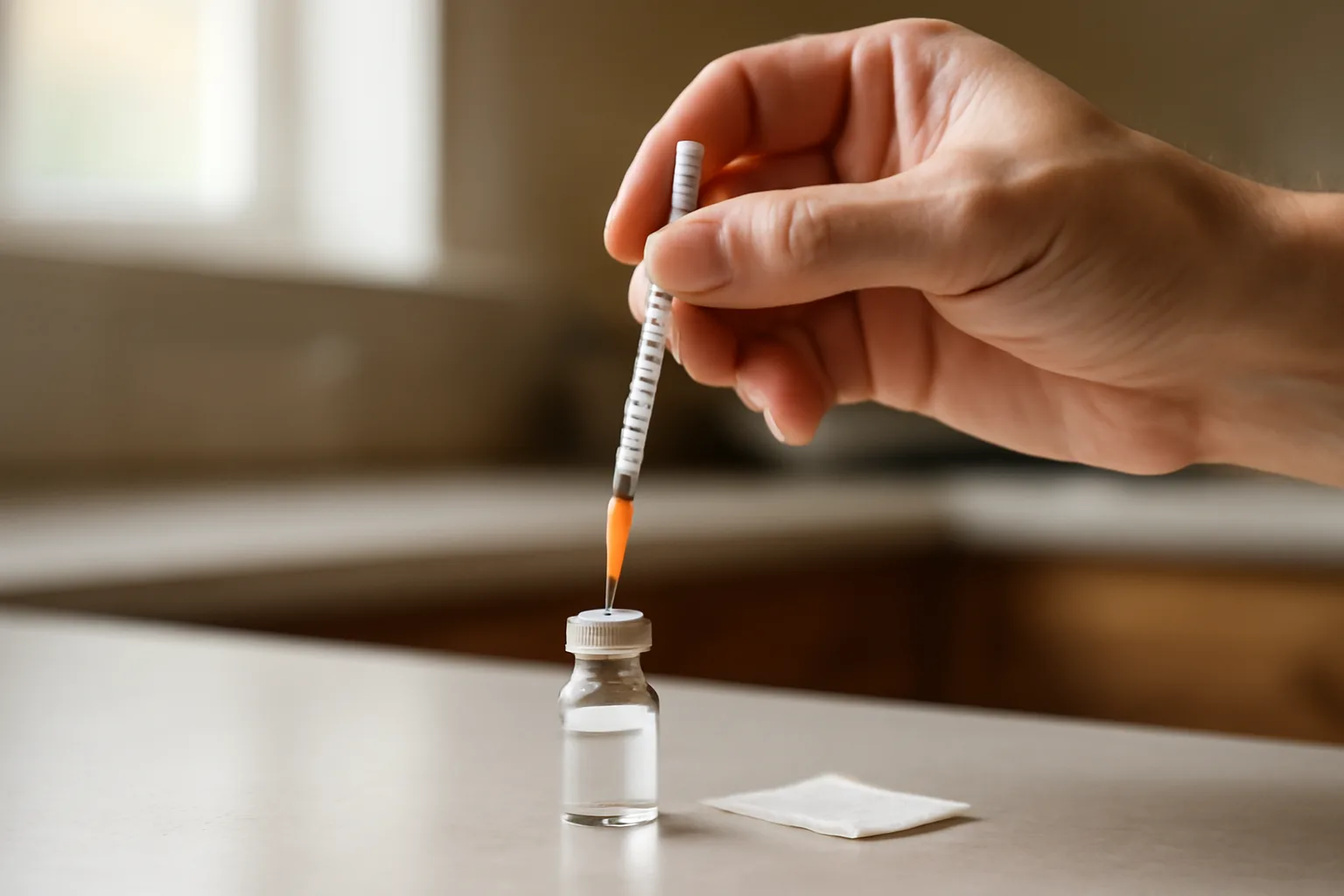
CJC-1295 is injected subcutaneously, usually into abdominal fat, with an insulin syringe (29-31 gauge). No-DAC versions are dosed once or twice daily on an empty stomach; DAC versions are dosed roughly once weekly. Reconstitute with bacteriostatic water, rotate sites, and store the mixed vial refrigerated. None of this is FDA-approved dosing; it comes from peptide manufacturer data sheets and off-label clinical use.
What is CJC-1295 and how is it actually administered?
CJC-1295 is a synthetic analogue of growth hormone-releasing hormone (GHRH). It is not an FDA-approved drug for any indication; it exists as a research chemical sold by compounding pharmacies (with a prescription) and by research-use-only vendors. The only way it works pharmacologically is as an injection. There's no oral, sublingual, or transdermal version with any real absorption data behind it, despite what some forum threads claim about troches or sprays. The route people actually use, in clinics and in self-administration, is subcutaneous (SubQ) injection. That means the needle goes into the fat layer just under the skin, not into muscle. This is the same basic technique diabetics use for insulin, and it's why most CJC-1295 kits are dosed and drawn with insulin syringes. GHRH analogues in general have been studied via subcutaneous dosing in the human research literature. Sermorelin, a related GHRH(1-29) analogue, had FDA-approved labeling that specified subcutaneous injection [1], and that's the same basic delivery logic manufacturers of CJC-1295 (a longer-acting GHRH analogue) carry over into their own product inserts. For background on the molecule itself and the trial data behind it, see CJC-1295.
What supplies do you need before you inject CJC-1295?
You need six things: the lyophilized (freeze-dried) peptide vial, bacteriostatic water for reconstitution, a mixing syringe, insulin syringes for dosing, alcohol swabs, and a sharps container. Skipping the sharps container is common and it's a bad habit; needle-stick injuries and improper disposal are a real public health issue, which is why states regulate home-generated sharps waste and the CDC publishes guidance on safe disposal of used needles and syringes at home [2]. Bacteriostatic water is water with 0.9% benzyl alcohol added as a preservative, which lets the reconstituted vial be used over multiple weeks instead of one shot. Plain sterile water without a preservative should be used promptly and then discarded, consistent with USP standards for sterile compounded preparations without an antimicrobial preservative [3]. Insulin syringes commonly come in 0.3 mL, 0.5 mL, and 1 mL sizes, marked in units (100 units = 1 mL). Needle gauges on these syringes typically run 29 to 31 gauge, which is thin enough that most people find subcutaneous injections with them close to painless once technique is dialed in. For dose math (how many mcg per unit on the syringe, given your vial's concentration), a cjc-1295 dac dosage calculator removes the guesswork; getting the concentration math wrong is the single most common self-administration error.
How do you reconstitute CJC-1295 before injecting it?
Reconstitution means adding liquid to the freeze-dried powder to make an injectable solution. The general steps mirror standard peptide reconstitution practice used across compounded peptide products: 1. Let the vial reach room temperature. 2. Swab the top of both the peptide vial and the bacteriostatic water vial with alcohol. 3. Draw bacteriostatic water into a syringe (commonly 1 to 3 mL, depending on desired concentration). 4. Insert the needle at an angle and inject the water down the inside wall of the vial, not directly onto the powder, to avoid excess foaming. 5. Gently swirl (don't shake) until the powder is fully dissolved. 6. Store the reconstituted vial refrigerated (2-8°C) and shielded from light. Most compounding references note that peptide stability in bacteriostatic water at refrigerated temperatures generally holds for several weeks, though exact stability data varies by peptide and isn't independently published for CJC-1295 specifically since it isn't an FDA-approved drug with a formal stability study on file. Treat any number beyond about 4 weeks refrigerated as an assumption carried over from similar peptides, not a proven shelf life for this exact molecule. If you're unsure about your target concentration, work backward from your intended microgram dose per injection, which is exactly what a dosage calculator is for; see cjc-1295 dosage for the reasoning behind common dose ranges.
Where on the body should you inject CJC-1295?
The standard sites are the same ones used for insulin and other subcutaneous peptides: the abdomen (at least an inch from the navel), the front of the thighs, the back of the upper arm, or the love-handle area of the flanks. Abdominal fat is the most commonly used site because it's easy to reach, has consistent fat thickness in most people, and offers a large rotation area. Rotating sites matters. Injecting the same quarter-inch spot every day causes lipohypertrophy (a lump of thickened fatty tissue) or lipoatrophy (a dent from fat loss), both of which are well documented in the insulin injection literature and apply the same way to any repeated subcutaneous peptide injection [4]. A simple rotation scheme: divide the abdomen into four quadrants and move clockwise each injection, then repeat. Avoid injecting into scar tissue, moles, stretch marks, or visibly bruised skin. If a site is sore or lumpy from a previous injection, skip it and give it time to resolve.
What is the actual injection technique, step by step?
Here's the sequence used in clinical subcutaneous self-injection training, adapted for peptide dosing: 1. Wash your hands. 2. Draw your dose from the reconstituted vial into the insulin syringe, checking the unit markings against your calculated dose. 3. Tap the syringe to move air bubbles to the top and expel them. 4. Swab the injection site with alcohol and let it air dry (injecting through wet alcohol stings more). 5. Pinch a fold of skin between two fingers. 6. Insert the needle at a 45 to 90 degree angle depending on your body fat and needle length; thinner people or shorter needles generally use 45 degrees, average subcutaneous fat with a 29-31 gauge insulin needle typically allows a 90 degree angle straight in. 7. Push the plunger slowly and steadily. 8. Withdraw the needle at the same angle it went in, and press (don't rub) an alcohol swab or gauze over the site for a few seconds. 9. Dispose of the needle immediately in a sharps container. There's no clinical reason to aspirate (pull back on the plunger to check for blood) with subcutaneous injections using a fine insulin needle; this used to be taught for intramuscular injections but current nursing guidance for SubQ technique generally omits it [4].
How does injection timing differ for CJC-1295 with DAC vs without DAC?
This is the single biggest practical difference in how people use this peptide, and it's not folklore, it's a function of the molecule's actual half-life. CJC-1295 without DAC (sometimes sold as "MOD-GRF 1-29" or "CJC-1295 no-DAC") has a short half-life, commonly cited in the 30-minute range based on peptide manufacturer characterization data, though independently published human pharmacokinetic data specific to this exact fragment is limited. Because it clears fast, it's typically injected once or twice daily, timed around a GH pulse: first thing in the morning on an empty stomach, and/or before bed, and often before or after training. Multiple small injections through the week is the whole point of the no-DAC version. CJC-1295 with DAC (DAC stands for Drug Affinity Complex, a modification that lets the peptide bind reversibly to albumin in the blood) has a dramatically longer half-life. The original peer-reviewed study on this modified GHRH analogue, published in the Journal of Clinical Endocrinology & Metabolism, reported a half-life of approximately 6.8 days after a single subcutaneous injection in healthy adults, with sustained elevation of GH and IGF-1 over multiple days [5]. Because of that long half-life, DAC formulations are dosed far less often, commonly once weekly or twice weekly, not daily. Mixing up these two products and dosing DAC daily (as if it were the short fragment) is a common and expensive mistake; it wastes peptide and pushes GH/IGF-1 elevation higher and longer than the studied dosing pattern. For a direct comparison of the two forms and the study data behind DAC specifically, see cjc-1295 with dac.
CJC-1295 (no-DAC) vs CJC-1295 with DAC: injection comparison
| Factor | CJC-1295 no-DAC | CJC-1295 with DAC | |
|---|---|---|---|
| Half-life | ~30 minutes (manufacturer data) | ~6.8 days (JCEM study) [5] | |
| Typical injection frequency | 1-2x daily | 1-2x weekly | |
| Best timing | Empty stomach, AM and/or pre-bed | Any consistent day/time, fasting preferred | |
| Site rotation need | High (frequent injections) | Lower (fewer injections) | |
| Common pairing | Ipamorelin, same syringe or back-to-back | Ipamorelin, separate schedule | |
| Regulatory status | Not FDA-approved; research/compounded use | Not FDA-approved; research/compounded use | Both forms are unapproved by the FDA for any human therapeutic use. Everything above reflects manufacturer characterization data and the single published pharmacokinetic study on the DAC form, not a large modern clinical trial base. |
Should you inject CJC-1295 with ipamorelin, and does timing change?
Ipamorelin is a ghrelin-receptor agonist (a growth hormone secretagogue) that works through a different receptor pathway than CJC-1295's GHRH-receptor mechanism. The rationale people give for pairing them is that GHRH analogues increase the amount of GH released per pulse while ghrelin-mimetics amplify the number and size of pulses, so combining the two mechanisms could produce a bigger GH response than either alone. That rationale is mechanistically reasonable and mirrors older combined GHRH plus GH-secretagogue research in the endocrinology literature, but there isn't a large modern controlled trial specifically testing CJC-1295 plus ipamorelin as a stacked protocol with defined health outcomes. Most of what circulates about "stacking ratios" and specific combined-dose numbers comes from peptide vendor guides and bodybuilding forums, not peer-reviewed trials. Treat it as a plausible, commonly used combination, not a proven synergistic protocol backed by outcome data. Practically, when people do combine them, they're usually drawn into the same syringe (both are compatible in bacteriostatic water at typical concentrations) and injected together, subcutaneously, at the same site and time, most often on waking and/or before bed. If you're running CJC-1295 no-DAC, the twice-daily timing lines up naturally with ipamorelin's own short half-life. If you're running the DAC version, ipamorelin is still usually dosed separately and more frequently, since its own half-life is much shorter than DAC's.
How much CJC-1295 should you inject per dose?
Dose ranges cited across compounding pharmacy references and peptide manufacturer sheets commonly fall between 100 and 300 mcg per injection for the no-DAC form, dosed once or twice daily, and a larger single dose (often cited around 1,000-2,000 mcg, i.e., 1-2 mg) once weekly for the DAC form, reflecting its accumulation over a longer interval. These are not FDA-established doses; they come from compounding pharmacy dosing sheets and manufacturer literature, not agency-reviewed labeling. Body weight, goals, and which form you're using all change the math, and getting the concentration-to-unit conversion wrong is the most common practical error people make (drawing 10 units of a 2000 mcg/mL solution is a very different dose than 10 units of a 5000 mcg/mL solution). Full dosing logic, by form and by goal, is covered in cjc-1295 dosage, and the calculator tool linked earlier converts your specific vial concentration into unit markings on the syringe.
What injection mistakes cause the most side effects or wasted product?
Injecting too fast is the most common cause of site pain and welting; pushing the plunger over 10-15 seconds instead of 2-3 seconds meaningfully reduces stinging and localized swelling with SubQ injections generally. Not rotating sites causes lipohypertrophy, the same lumpy fat buildup seen in long-term insulin users who favor one spot [4]. Once it develops, absorption from that site becomes inconsistent, which can make dosing feel unpredictable even though the actual dose drawn didn't change. Injecting cold peptide straight from the fridge stings more than letting the syringe warm to near room temperature for a minute first. Using non-bacteriostatic water and then storing the vial for weeks anyway risks microbial contamination; that water isn't designed for extended multi-dose use without a preservative [3]. Finally, dosing DAC on a no-DAC schedule (daily instead of weekly) is a stacking error specific to this peptide family, and it comes directly from confusing the two products' pharmacokinetics, discussed above. For the fuller side effect profile, injection-site reactions, water retention, flushing, and what's actually reported versus assumed, see cjc-1295 side effects.
How do you store CJC-1295 before and after mixing?
Unreconstituted (powder) vials are generally stored in a refrigerator or freezer, shielded from light, per typical peptide manufacturer handling instructions; freeze-dried peptides are relatively stable in this state for extended periods, though exact shelf-life claims vary by manufacturer and aren't independently verified by FDA review since these aren't approved drug products. Once reconstituted with bacteriostatic water, the vial should go straight into the refrigerator (2-8°C), not the freezer; freezing a liquid peptide solution can degrade it through freeze-thaw cycling. Keep it away from direct light and try to use it within the timeframe your source recommends, generally on the order of a few weeks. Always inspect before drawing a dose: cloudiness, visible particles, or discoloration are reasons to discard a vial rather than inject it.
Where do you get CJC-1295 and does the source affect injection safety?
Source matters more for injection safety than almost anything covered above, because contamination, mislabeled concentration, and incorrect sterility are the failure modes that actually hurt people, not needle angle. CJC-1295 is legally available in the U.S. through licensed compounding pharmacies, generally requiring a prescription from a physician following an evaluation, and that route carries pharmacy-grade sterility and accurate labeled concentration. Non-pharmacy "research chemical" vendors are far more variable in verified purity, sterile handling, and accurate labeling; there's no FDA review of these products before they reach a buyer. CJC-1295 Co reviews providers against these criteria and points readers toward a provider-reviewed route, with a named fulfilling pharmacy partner, rather than unverified research-chemical vendors. For a walkthrough of what to check before buying (lab testing, prescription requirements, pharmacy accreditation), see cjc-1295 for sale.
Is at-home CJC-1295 injection legal and how is it regulated?
CJC-1295 itself is not an FDA-approved drug, so there is no FDA-reviewed label, approved dose, or approved indication for it. It is legally compounded and dispensed by licensed pharmacies under a physician's prescription in the framework that governs compounded drug products generally, and the FDA maintains public guidance on how compounding fits into its regulatory scheme [6]. Buying it without a prescription from an unregulated research-chemical seller sits in a legal gray zone that varies by state and by how the product is marketed; "not for human consumption" labeling on these products exists specifically to route around drug regulation, not because the seller expects lab use. Self-injecting anything at home carries the same basic safety rules regardless of legal status: sterile technique, a sharps container, and disposal through your local household sharps program or pharmacy take-back, consistent with CDC guidance on safe home sharps disposal [2].
Frequently asked questions
Is CJC-1295 injected into muscle or under the skin?
Under the skin (subcutaneous), not into muscle. It's drawn and injected the same way insulin is, using a short, thin insulin syringe, into the fat layer of the abdomen, thigh, or upper arm. Intramuscular injection isn't the standard method described in manufacturer or compounding pharmacy dosing instructions for this peptide.
What size needle do you use for CJC-1295?
Most people use an insulin syringe with a 29 to 31 gauge needle, in a 0.3, 0.5, or 1 mL barrel size marked in units. These are the same needles used for insulin and most subcutaneous peptide injections, chosen for minimal discomfort at the shallow depth required for fat-layer delivery.
What's the difference between CJC-1295 and CJC-1295 with DAC for injection purposes?
No-DAC CJC-1295 has a very short half-life (roughly 30 minutes) and is injected once or twice daily. CJC-1295 with DAC binds to blood albumin and has a measured half-life of about 6.8 days in a published pharmacokinetic study, so it's injected only once or twice weekly [5]. Confusing the two schedules is a common and costly mistake.
Should you inject CJC-1295 in the morning or at night?
No-DAC CJC-1295 is commonly injected on an empty stomach first thing in the morning and/or before bed, timed to line up with the body's natural nighttime GH pulse. DAC versions are dosed once or twice weekly, so time of day matters less than picking a consistent day and staying fasted around the injection.
Can you inject CJC-1295 and ipamorelin in the same syringe?
Yes, they're commonly drawn into the same syringe and injected together subcutaneously, since both are compatible in bacteriostatic water at typical concentrations. The combination is mechanistically plausible (different receptor pathways) but hasn't been validated in large controlled trials as a specific stacked protocol with defined outcomes.
How do you reconstitute CJC-1295 powder?
Add bacteriostatic water slowly down the inside wall of the vial (commonly 1-3 mL depending on desired concentration), swirl gently without shaking until fully dissolved, and refrigerate the mixed vial. Bacteriostatic water contains a preservative that allows multi-week use; plain sterile water without a preservative should be used promptly, consistent with USP sterile compounding standards [3].
How long does reconstituted CJC-1295 last in the fridge?
Manufacturer and compounding references generally suggest several weeks refrigerated at 2-8°C, shielded from light, though there's no independently published, peptide-specific stability study establishing an exact number since CJC-1295 isn't an FDA-approved product. Discard the vial if you see cloudiness or particles regardless of how much time has passed.
What happens if you inject CJC-1295 into a vein by accident?
Subcutaneous technique with a short insulin needle at the correct angle makes hitting a vein very unlikely, since the needle only reaches the fat layer, not deeper vascular tissue. If a site bleeds more than a drop or bruises heavily, switch sites next time and apply gentle pressure; this isn't typically a medical emergency but repeated issues warrant checking your technique or angle.
Where's the best injection site for CJC-1295?
The abdomen, at least an inch from the navel, is the most commonly used site because of its consistent fat layer and ease of access, followed by the front thighs and back of the upper arm. Rotate sites with each injection to prevent lipohypertrophy, the same lumpy tissue buildup documented in long-term insulin injectors [4].
Do you need to pinch your skin before injecting CJC-1295?
Pinching a fold of skin is standard technique for subcutaneous injection, especially for leaner individuals or when using a longer needle, since it helps keep the needle in the fat layer rather than muscle. With very short insulin needles (4-6mm) some people inject at 90 degrees without pinching; either approach is acceptable subcutaneous technique.
Can you buy CJC-1295 legally without a prescription?
Through a licensed U.S. compounding pharmacy, no; it generally requires a prescription following physician evaluation. It's also sold by "research chemical" vendors labeled not for human use, which sits in a legal gray area and carries much less certainty around sterility, purity, and accurate labeled concentration than the pharmacy route.
How many units do you draw for a typical CJC-1295 dose?
It depends entirely on your vial's concentration (mcg per mL) and your target dose in mcg; there's no universal unit number. A dosage calculator that converts your specific concentration into syringe units is the reliable way to avoid under- or overdosing; see the cjc-1295 dac dosage calculator.
Sources
- FDA, Geref (sermorelin acetate) approved labeling, NDA 019787: Subcutaneous injection is the labeled route for the related GHRH analogue sermorelin
- CDC, "Safe Injection Practices" and home sharps disposal guidance, MMWR: Public health guidance requires proper sharps container disposal for home injections
- USP General Chapter <797> Pharmaceutical Compounding - Sterile Preparations overview, U.S. Pharmacopeia: Multi-dose sterile preparations without preservative have short beyond-use dating, generally within 24 hours absent bacteriostatic preservative
- American Diabetes Association, "Insulin Storage and Syringe Safety": Site rotation prevents lipohypertrophy in repeated subcutaneous injections
- Teichman SL, et al., Journal of Clinical Endocrinology & Metabolism (2006), PMID 16352683: CJC-1295 with DAC has a half-life of approximately 6.8 days and sustains elevated GH/IGF-1 after a single subcutaneous injection
- FDA, Compounding and the FDA: Questions and Answers: Compounded drug products, including peptides like CJC-1295, are dispensed under a framework separate from FDA drug approval