Last updated 2026-07-26
TL;DR
CJC-1295 is dosed subcutaneously, almost always into abdominal fat, using an insulin syringe (29-31 gauge). Rotate sites by an inch or two each injection to avoid lumps and scar tissue. No-DAC versions are typically injected daily due to a short half-life; DAC versions are dosed less often. None of this is FDA-approved use, so dosing and site practice come from peptide chemistry and general subcutaneous injection guidance, not a labeled product insert.
Where do you inject CJC-1295?
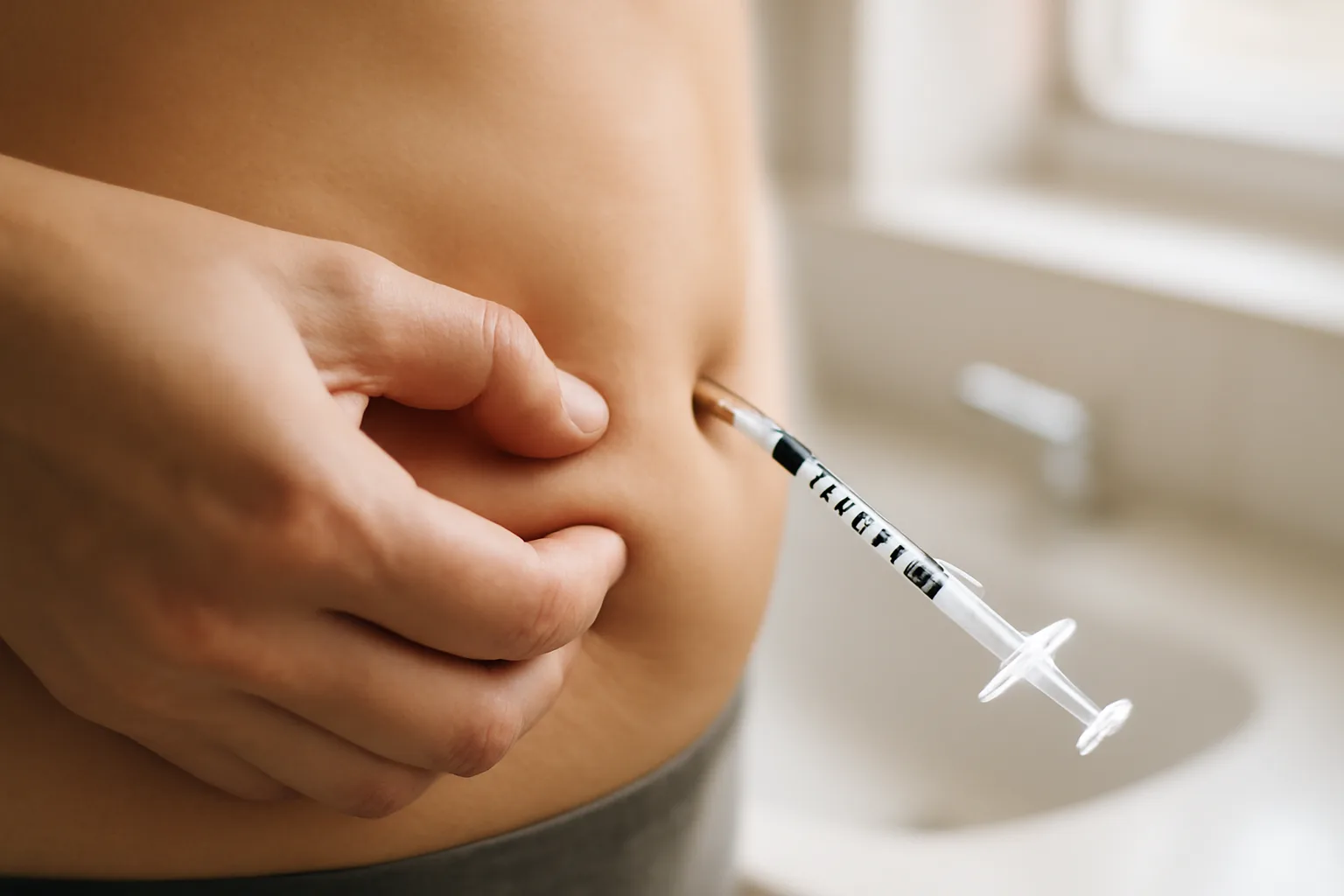
CJC-1295 is given as a subcutaneous (subQ) injection, meaning it goes into the fat layer just under the skin, not into muscle. The most common site is the abdomen, roughly two inches out from the navel, because there's usually enough fat there for a clean subQ pocket and it's easy to reach yourself. Other workable subQ sites include the front of the thigh (the fleshy part above the knee and below the hip) and the back of the upper arm, though the arm is hard to self-inject without help because of the angle. The general clinical guidance for any subcutaneous injection, whether it's insulin, a GLP-1 drug, or a research peptide, is the same: pinch a fold of fat, insert the needle at roughly a 45 to 90 degree angle depending on needle length and body fat, and inject slowly [1]. The reason subQ is used instead of intramuscular (IM) for peptides like CJC-1295 comes down to absorption kinetics and comfort. Subcutaneous tissue has fewer blood vessels than muscle, so uptake is slower and steadier, which matters for a compound meant to nudge growth hormone pulses rather than spike them. It's also simply less painful and lower-risk for self-injection than IM. That's why insulin and most peptide protocols default to subQ [1].
Why does injection site even matter for a peptide like this?
Site matters for three practical reasons: absorption consistency, tissue health, and comfort. None of this is unique to CJC-1295, it's basic subcutaneous injection science that applies to insulin, HGH, and other small peptide drugs. Absorption can vary by region because fat thickness and local blood flow differ. This is well documented with insulin, where studies have shown faster absorption from the abdomen than from the thigh or buttock, and site rotation guidance exists specifically because repeated injections in the same spot cause lipohypertrophy (fatty lumps under the skin) that can slow and make absorption unpredictable [2]. There's no dedicated absorption study for CJC-1295 specifically, so this is inference from the broader subQ peptide literature, not a CJC-1295-specific trial. It's a reasonable inference, not a confirmed fact for this molecule. Tissue health is the bigger practical issue for anyone injecting daily or near-daily. Hitting the same quarter-inch of skin night after night is what causes those lumps, welts, and eventually scar-tissue nodules that some long-term self-injectors report on forums. That's folklore-adjacent (it's not published data on CJC-1295 users specifically) but it lines up exactly with the decades of insulin lipohypertrophy literature, so it's a credible concern [2]. Comfort is the last piece. The abdomen generally has more subQ fat and fewer nerve endings than the thigh, so most people find it the least painful default site.
How do you rotate injection sites correctly?
Rotate in a pattern, not randomly, and give each spot time to recover. A simple approach: divide the abdomen into a grid (left, right, upper, lower, each a couple inches from the navel and from any old injection mark), and move to the next square each time, cycling through before repeating a spot. A commonly cited rule from insulin injection guidance is to keep injections at least one inch (about 2.5 cm) apart within the same region, and to not reuse the exact same point for at least a few weeks [2]. There's no CJC-1295-specific rotation study, so this number is borrowed from the insulin literature; treat it as a sensible floor, not a peptide-specific finding. For someone injecting daily, a practical rotation looks like: abdomen for a week, then thigh for a few days, then back to the other side of the abdomen. People who dose multiple peptides at once (say CJC-1295 in the morning and something else at night) sometimes use different regions entirely to keep track of what went where and to halve the load on any one area. Signs you're not rotating enough: a firm or numb spot that doesn't fade in a day or two, visible dimpling, or bruising that keeps recurring in the same place. If you see that, give the area weeks off, not days.
What supplies do you need (needle gauge, syringe size)?
Most people use an insulin syringe, typically 29 to 31 gauge, 0.3 to 0.5 mL (30 to 50 unit) capacity, with a needle length around 4 to 8 mm (5/16 to 1/2 inch). These are the same syringes used for insulin and are sized specifically for shallow subcutaneous depth, not muscle. A finer gauge (higher number) means a thinner needle, which generally hurts less but can be slightly harder to draw thicker solutions through. Since reconstituted CJC-1295 is a thin, watery solution, a 29-31G needle draws and injects without much resistance. Standard subQ injection technique, per general clinical and nursing guidance, involves cleaning the site with an alcohol swab, letting it dry (injecting into wet alcohol stings), pinching a fold of skin, inserting the needle at the angle appropriate to needle length and fat thickness, injecting steadily, then withdrawing and applying light pressure without rubbing [1]. None of this is specific to CJC-1295; it's the standard subQ protocol taught for any self-injected small-volume drug. Don't reuse needles. Beyond basic sterility, needles dull after a single use, which makes each subsequent injection more likely to bruise or hurt.
Does CJC-1295 with DAC use different injection sites or timing than without DAC?
The injection site itself doesn't change (both forms are subQ), but the dosing frequency, and therefore how often you're picking a new site, is very different between the two versions. CJC-1295 without DAC (sometimes sold as "Mod GRF 1-29") has a short half-life, commonly cited around 30 minutes, because without the Drug Affinity Complex (DAC) piece, it's cleared from circulation quickly [3]. That short half-life is why the no-DAC version is typically dosed once or twice daily, meaning frequent injections and a real need for a rotation plan. CJC-1295 with DAC binds to albumin in the blood via its DAC modification, which extends its circulating half-life dramatically. The peptide's developers reported a half-life of about 6 to 8 days in the original pharmacokinetic characterization published in the Journal of Clinical Endocrinology & Metabolism, where a single injection sustained elevated GH and IGF-1 levels for multiple days [3]. Because of that extended half-life, DAC versions are dosed far less often (weekly or twice-weekly in most protocols circulating online), which means fewer total injections and less rotation pressure, though the sites used are the same abdominal/thigh subQ spots. It's worth being precise here: the JCEM study measured a single-dose pharmacokinetic profile in healthy volunteers and reported sustained GH elevation over a multi-day window, not a specific injection-site comparison and not long-term safety data on repeated self-administration [3]. Almost everything about weekly vs. twice-weekly DAC dosing schedules seen in forums is extrapolation from that pharmacokinetic curve, not a separate dosing trial. For a deeper comparison of the two forms, see CJC-1295 with DAC vs without DAC.
Why is CJC-1295 usually paired with ipamorelin, and does that change injection site strategy?
CJC-1295 and ipamorelin are commonly combined because they act on two different receptor pathways that both raise growth hormone release: CJC-1295 is a growth-hormone-releasing hormone (GHRH) analogue, while ipamorelin is a ghrelin-receptor agonist (a GH secretagogue in the same family as GHRP-2 and GHRP-6, but described as more selective for GH release with less effect on cortisol and appetite hormones in early pharmacology work) [4]. The rationale is that stacking a GHRH analogue with a ghrelin-mimetic can produce a larger, more synchronized GH pulse than either alone, because they work through separate receptors on the pituitary somatotroph. That rationale is mechanistic, not a settled clinical outcome. There isn't a large randomized trial specifically testing CJC-1295 plus ipamorelin combination therapy against either drug alone in humans; most of what's cited for the combination comes from separate pharmacology studies of each peptide individually, plus the general endocrine principle that GHRH and ghrelin-receptor pathways are additive in animal and small human GH-secretion studies [4]. Anyone telling you the stack is proven to outperform either peptide alone is overstating the evidence. On injection site specifically, the two peptides are typically drawn into the same syringe and given as a single subQ shot (they're chemically compatible when reconstituted together, which is why compounding sources often sell them as a combined vial). That means combining them doesn't add injection burden or require a separate rotation site, it's still one shot, same subQ zones, same rotation logic as CJC-1295 alone.
How do you reconstitute and store CJC-1295 before injecting?
CJC-1295 arrives as a lyophilized (freeze-dried) powder that needs reconstitution with bacteriostatic water before it can be drawn into a syringe. Bacteriostatic water (water containing 0.9% benzyl alcohol as a preservative) is standard for multi-dose peptide vials because it lets the reconstituted solution stay usable for weeks rather than needing to be used in one shot, unlike plain sterile water. General peptide reconstitution practice: inject the bacteriostatic water slowly down the inside wall of the vial (not directly onto the powder, which can damage the peptide structure), and swirl gently rather than shaking. Once reconstituted, peptides like CJC-1295 are typically stored refrigerated (roughly 2-8°C) and used within the timeframe stated by whoever supplied it, since manufacturer-specific stability data (not a general peptide-class rule) determines how long a reconstituted vial actually stays potent. None of this reconstitution guidance comes from an FDA drug label, because CJC-1295 doesn't have one. It's derived from general peptide-handling practice used across the compounding and research-chemical industry, so specifics (exact diluent volume, exact bacteriostatic water brand, exact refrigerated shelf life) will vary by the specific product and should follow whatever documentation the supplying pharmacy provides.
What does the actual safety and regulatory picture look like?
CJC-1295 is not an FDA-approved drug. It has no approved indication, no FDA-reviewed dosing label, and no FDA safety monitoring specific to it. Everything about injection site, frequency, and reconstitution used in the peptide community is derived from published pharmacokinetic studies (mostly single or short-term dosing in small groups) and general subQ injection practice, not from a completed drug approval process [3]. The FDA has also taken a specific negative stance on CJC-1295 in the compounding context. The agency's 2016 review of substances nominated for the 503A bulk drug substances list evaluated CJC-1295 and concluded there was insufficient data to support a positive recommendation, citing concerns about the lack of adequate safety information to justify compounding use [5]. Practically, this means legitimate access should run through a pharmacy that requires provider oversight and sources through vetted, quality-controlled supply chains rather than anonymous online vials with no chain of custody. CJC-1295 Co works with a provider-reviewed process and names its fulfilling pharmacy partner precisely because sourcing and oversight is the biggest real-world risk factor here, not injection technique. Local site reactions (redness, mild swelling, a small bruise) are the most commonly reported issues with subQ peptide injections generally, consistent with subQ injection reactions across drug classes [1]. Because CJC-1295 lacks large-scale controlled human safety trials, rarer or longer-term risks aren't well characterized, and anyone using it should treat that uncertainty as real, not theoretical.
Injection site comparison: abdomen vs thigh vs arm
| Site | Ease of self-injection | Typical fat depth | Common use case | |
|---|---|---|---|---|
| Abdomen (2 in from navel) | Easiest, most common | Moderate to high | Default site for daily subQ dosing | |
| Thigh (upper, front) | Easy, good alternate | Moderate | Rotation site to rest the abdomen | |
| Upper arm (back/triceps) | Hard alone, needs a helper | Low to moderate | Least used for self-injection | This comparison reflects general subQ injection guidance applied across insulin, GLP-1 drugs, and peptides, not a CJC-1295-specific site trial [1][2]. The abdomen wins on convenience and fat depth for most adults; the thigh is the standard fallback for rotation; the arm is rarely practical without a second person. |
What mistakes actually cause pain, bruising, or lumps?
Injecting too shallow (into the dermis rather than the fat layer) is one of the most common causes of stinging pain and small red welts. This usually happens when the needle angle is too flat or the pinch isn't held properly. Injecting too fast pushes fluid into a small area faster than the tissue can accommodate, which causes a painful bubble and more bruising. Slow, steady plunger pressure over several seconds is standard subQ technique [1]. Reusing the same spot without rotation eventually thickens the tissue (lipohypertrophy in the insulin literature), which both hurts more over time and can make absorption less predictable [2]. Not letting the alcohol dry before inserting the needle causes stinging as alcohol gets carried into the tissue. And injecting into a vein rather than fat (rare with a short 29-31G needle at the right angle, but possible in very lean people) causes disproportionate bruising and should prompt switching sites and possibly needle length.
How does this compare to other GH secretagogue routes?
CJC-1295 is exclusively subcutaneous in essentially all circulating protocols; it isn't taken orally (peptides of this size are broken down by digestion) and isn't typically given IM, since IM absorption is faster and less suited to a peptide meant to create a smoother GH pulse pattern. This differs from some other GH-axis compounds. Recombinant human growth hormone (somatropin) itself is also subQ but is FDA-approved with labeled dosing for specific indications like GH deficiency, unlike CJC-1295. Oral GH secretagogues in actual FDA-approved use, such as the ghrelin-mimetic tablets, exist for specific approved conditions, but CJC-1295 and ipamorelin are not part of that approved category, they remain compounded/research-grade peptides given by injection only. If you're comparing the injection burden of CJC-1295 (daily, no-DAC) against DAC-extended dosing, see CJC-1295 dosing guide for the frequency math, and check ipamorelin and CJC-1295 stacking for how the combined shot is typically dosed by weight.
Frequently asked questions
Do you inject CJC-1295 into muscle or under the skin?
Under the skin (subcutaneous), not into muscle. Subcutaneous injection is standard for CJC-1295 across essentially all circulating protocols because it produces slower, steadier absorption than intramuscular injection and is easier and less painful to self-administer [1].
Where is the best place to inject CJC-1295?
The abdomen, roughly two inches from the navel, is the most commonly used site because it usually has enough subcutaneous fat and is easy to reach yourself. The thigh is a common rotation site. The upper arm works but is hard to self-inject without help.
How often should you rotate CJC-1295 injection sites?
Rotate every injection, moving at least an inch from the last spot, and avoid reusing the exact same point for a few weeks. This mirrors insulin injection guidance aimed at preventing lipohypertrophy (fatty lumps) from repeated same-spot injections [2].
What size needle do you use for CJC-1295?
Most people use an insulin-style syringe, 29 to 31 gauge, with a needle length around 4 to 8 mm, sized for shallow subcutaneous depth rather than muscle. This is the same syringe type commonly used for insulin injections.
Does CJC-1295 with DAC get injected differently than without DAC?
No, both are subcutaneous. What differs is frequency: no-DAC CJC-1295 has a short half-life (about 30 minutes) and is typically dosed daily, while DAC versions have a half-life reported around 6 to 8 days in pharmacokinetic studies and are dosed far less often [3].
Can you inject CJC-1295 and ipamorelin in the same syringe?
Yes, they're commonly reconstituted and drawn together as a single subQ shot, since they're chemically compatible in solution. This is why many compounding sources sell them pre-combined in one vial rather than as two separate products.
Why do people combine CJC-1295 with ipamorelin instead of using either alone?
CJC-1295 is a GHRH analogue and ipamorelin is a ghrelin-receptor agonist, two separate pathways that both stimulate GH release from the pituitary [4]. The rationale for stacking them is mechanistic additivity, not a proven clinical outcome; no large trial has directly tested the combination against either peptide alone.
Is it painful to inject CJC-1295?
Most people describe it as a mild pinch, similar to an insulin injection, assuming proper technique (dry alcohol, correct angle, slow injection). Pain usually signals a technique issue: too shallow, too fast, or reusing an irritated site.
How do you reconstitute CJC-1295 before injecting?
CJC-1295 comes as a freeze-dried powder reconstituted with bacteriostatic water, injected slowly down the vial wall and swirled (not shaken). Reconstituted vials are typically refrigerated and used within a supplier-specified window, since there's no standardized FDA shelf-life data for this compound.
Is CJC-1295 FDA-approved for injection use?
No. CJC-1295 has no FDA-approved indication or label. The FDA's 2016 evaluation of substances nominated for 503A compounding found insufficient data to support a positive recommendation for CJC-1295, citing safety concerns [5]. Any use happens outside standard drug approval oversight.
What happens if you keep injecting the same spot?
Repeated injections in the same small area can cause lipohypertrophy, firm or lumpy fatty tissue buildup, which is well documented in the insulin injection literature and is why site rotation guidance exists [2]. It can also make absorption less predictable over time.
Can you inject CJC-1295 in the same site as other peptides or medications?
It's generally better to keep at least an inch of separation between different injections given close together, and to track which peptide went where if you're using more than one. This isn't a CJC-1295-specific rule, it follows general subQ site-rotation practice [2].
Sources
- MedlinePlus, Self-Injection: Subcutaneous: Standard subcutaneous injection technique: pinch skin, insert at correct angle, inject slowly, general practice applied to CJC-1295 dosing
- Frid AH et al., Mayo Clinic Proceedings, New Insulin Delivery Recommendations (2016), PMID 27259396: Site rotation and lipohypertrophy prevention guidance from insulin injection practice, applied by analogy to peptide subQ injections
- Teichman SL et al., Journal of Clinical Endocrinology & Metabolism (2006): CJC-1295 with DAC pharmacokinetics, half-life of approximately 6-8 days and sustained GH/IGF-1 elevation after a single dose
- Raun K et al., European Journal of Endocrinology (1998), ipamorelin pharmacology: Ipamorelin acts as a ghrelin-receptor agonist with selective GH-releasing activity and minimal effect on cortisol and other hormones in early pharmacology studies
- U.S. Food and Drug Administration, 503A Bulks List Nominations: CJC-1295 Evaluation (2016): FDA nominated-substance evaluation for CJC-1295 citing insufficient safety data for compounding use