Last updated 2026-07-26
TL;DR
A real CJC-1295 certificate of analysis (COA) reports purity (usually HPLC, ideally >98%), identity (mass spec), peptide content, and often endotoxin/microbial results, all tied to a specific lot number from an accredited or at least named third-party lab. Most vendor COAs online are undated, unsigned, or reused across lots. Treat a COA as a starting point for questions, not proof of what's in the vial.
What is a certificate of analysis for CJC-1295, exactly?
A certificate of analysis (COA) is a lab report that describes what was found in a specific sample of material, at a specific point in time. For a research peptide like CJC-1295, a proper COA usually comes from testing a batch of lyophilized powder before it's vialed and shipped. It's a snapshot, not a guarantee about the vial that eventually reaches your freezer. The FDA's own guidance on compounded and research-use substances stresses that identity and strength testing has to be tied to the actual batch being distributed, not a generic reference standard [1]. That distinction matters more than most buyers realize. A COA that says "CJC-1295, 98% purity" without a lot number, a test date, or a named lab is functionally just a claim on a webpage. It's not evidence. CJC-1295 itself is not FDA-approved for any human use, and it is not legally marketed as a drug or supplement. It exists almost entirely as a "research use only" chemical sold to researchers, which is also why formal, standardized quality requirements (the kind that apply to approved drugs under 21 CFR Part 211) don't apply to most sellers [2]. That gap is exactly why the COA becomes the main thing a buyer has to lean on, and exactly why it's so often weak.
What should a legitimate CJC-1295 COA actually contain?
| Identity | Mass spectrometry (MS) confirming molecular weight matches CJC-1295's sequence | No identity test, or "identity confirmed" with no method listed | |
|---|---|---|---|
| Purity | HPLC (high-performance liquid chromatography) chromatogram or numeric result, typically reported >98% for research-grade peptide | A single percentage with no chromatogram or method | |
| Peptide content/net mass | Amount of actual peptide vs. counter-ions, salts, and residual moisture (often 70-90% of total powder weight) | No mention of net peptide content at all | |
| Endotoxin | Limulus amebocyte lysate (LAL) test, reported in EU/mL | Missing entirely (common) | |
| Microbial/sterility | Bioburden or sterility testing if the product claims sterile filtration | Claims "sterile" with no supporting test | |
| Lab identity | Named, independent lab with accreditation (ISO 17025 is the relevant standard for testing labs) [3] | "In-house testing" or an unnamed lab | The peptide content line is one buyers skip past constantly. A powder can be 99% pure by HPLC (meaning 99% of what eluted was the intended peptide, not a contaminant) while still being only 75-80% peptide by mass, with the rest being acetate salts and bound water. Both numbers can be true and non-contradictory. If a COA only reports purity and never touches net content, you don't actually know how much peptide is in the vial, which matters directly for dosing. |
A COA worth trusting has several concrete elements, more than a purity percentage in bold text. At minimum, expect: a lot or batch number that matches the vial label, the test date, the name of the testing lab (more than "3rd party lab"), the analytical method used, and quantitative results, more than pass/fail. Here's what each piece should look like: | Element | What a real COA shows | Red flag |
How do I know if a CJC-1295 COA is fake or reused?
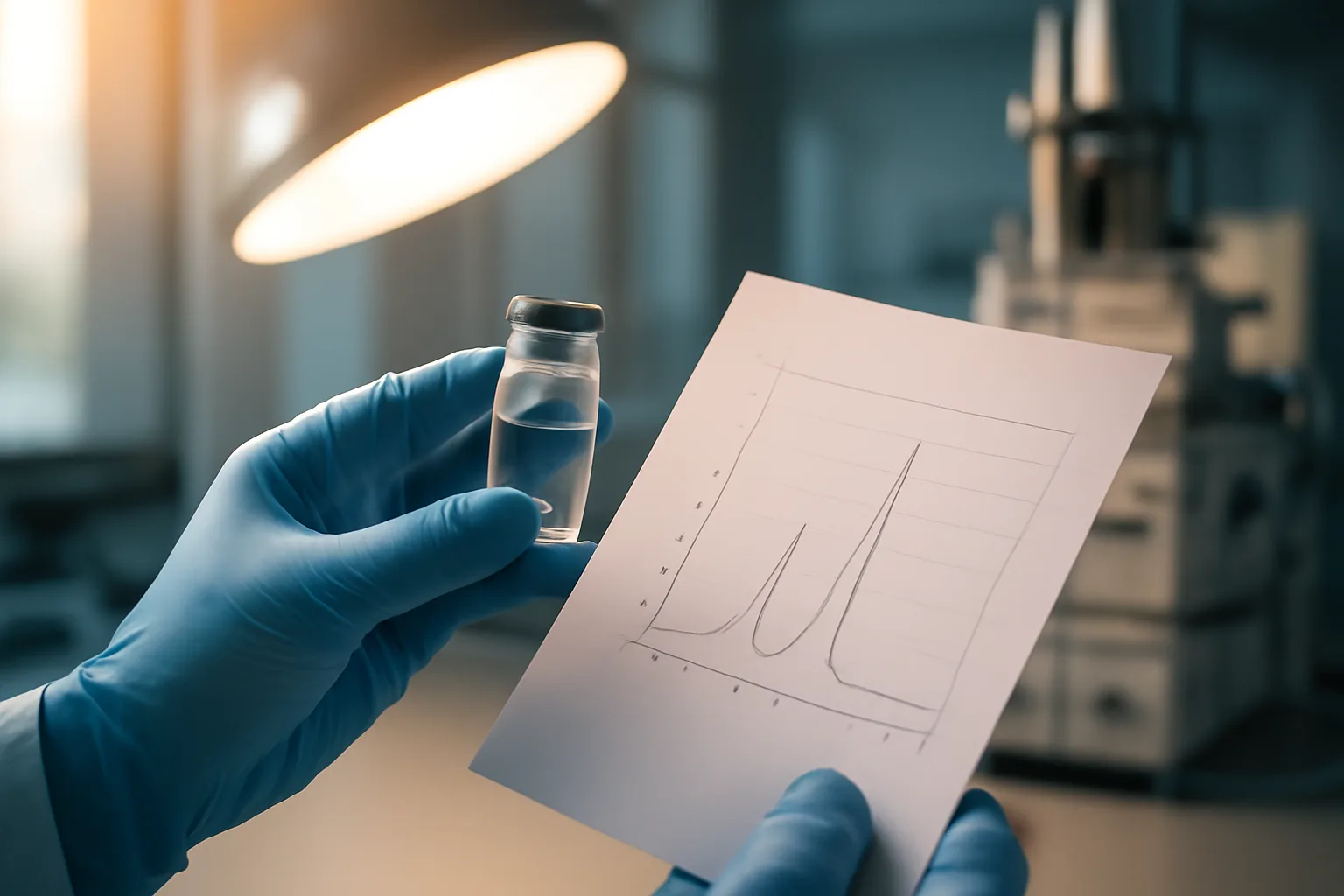
The honest answer is you often can't be fully sure from the document alone, but there are tells. The most common shortcut vendors take is reusing one COA across many production lots, sometimes for months or years. If the lot number on your vial doesn't match the lot number on the COA, the document tells you nothing about your specific vial. Check these things in order: 1. Does the lot number on the COA match the lot number printed on the vial label? If there's no lot number on either, that's already disqualifying. 2. Is the test date recent relative to when the batch was likely made? A COA dated three years ago attached to a "fresh" vial is a mismatch worth asking about. 3. Is the testing lab named and searchable? Labs that do this work (mass spec, HPLC, LAL testing) are real businesses with websites, accreditations, and often listed clients. If a two-second search turns up nothing, be skeptical. 4. Does the chromatogram look plausible? A genuine HPLC trace has a dominant peak with a retention time, baseline noise, and usually a small integration table. A blurry screenshot or a hand-drawn-looking graph is a red flag. 5. Can you request a COA tied to your actual order, not a generic PDF from the product page? A seller willing to provide a batch-specific document, on request, is behaving more like an actual research supplier.
Why do so many CJC-1295 vendors skip endotoxin and sterility testing?
Cost and speed, mostly. Endotoxin (LAL) testing and full microbial panels add real expense per batch, and for a product sold as "research use only" with no legal requirement to test at all, many sellers simply don't. This is one of the biggest gaps between what a buyer assumes ("third-party tested" implies every test that matters) and what actually gets tested (often just an HPLC purity check). Endotoxin matters because bacterial endotoxin can survive processes that kill the bacteria themselves, and it can trigger fever, inflammation, or worse if injected in sufficient quantity. The FDA's guidance for sterile drug products references endotoxin limits calculated from patient weight and route of administration as a baseline safety concept, precisely because this risk is well understood in pharmaceutical manufacturing [4]. Research peptide sellers operating outside that framework aren't bound by those limits, which is exactly why a COA that includes an actual LAL result (more than the word "sterile") is worth more than one that doesn't.
CJC-1295 with DAC vs without DAC: does the COA look different?
Yes, and this distinction trips people up constantly because it changes what the COA should even be testing for. CJC-1295 without DAC (sometimes labeled "Mod GRF 1-29") is a shorter-acting GHRH analogue with a half-life measured in minutes. CJC-1295 with DAC has a Drug Affinity Complex attached, a modification that lets it bind serum albumin, which is why the original published pharmacokinetic work found it extends the compound's half-life to roughly 6 to 8 days in humans, versus minutes for the unmodified peptide [5]. A COA for the DAC version needs to confirm identity against a larger molecule (DAC adds meaningful molecular weight), so the mass spec target mass on the COA should be noticeably higher than for the no-DAC version. If a vendor's COA for "CJC-1295 with DAC" shows a molecular weight that matches plain Mod GRF 1-29, something is wrong, either mislabeling or a genuine identity problem. This is one of the few places where checking the actual number on the mass spec result against the published molecular weight for each variant is worth the two minutes it takes. For a fuller breakdown of what changes clinically and practically between the two, see CJC-1295 DAC or no-DAC.
Why is CJC-1295 usually paired with ipamorelin, and does the COA cover both?
CJC-1295 is a GHRH (growth hormone releasing hormone) analogue, meaning it works on the pituitary's GHRH receptor to stimulate growth hormone release. Ipamorelin is a ghrelin receptor agonist (a GH secretagogue in a different family), working through a separate receptor pathway. The rationale for combining them, which shows up repeatedly in the peptide research literature on GH secretagogues, is that GHRH analogues and ghrelin-mimetic peptides act on different receptors and can produce an additive or synergistic GH pulse when combined, an approach studied in various secretagogue combinations going back decades [6]. That's the mechanistic logic; it is not the same as a body of clinical trials establishing a specific dose, ratio, or outcome for the CJC-1295 plus ipamorelin combination specifically, and readers should treat forum-reported ratios and stacking protocols as anecdote, not evidence. If you're buying the two peptides together, whether as separate vials or a pre-mixed blend, you need two COAs, not one. A blended vial should have its own COA testing the finished mixture (confirming both peptides are present at expected ratios), separate from the individual COAs for each raw peptide. Vendors that sell a "CJC-1295/Ipamorelin blend" but only supply a COA for one component, or for neither, are asking you to trust the label alone.
What does 'third-party tested' actually mean on a peptide product page?
It should mean an independent lab, with no ownership or financial ties to the seller, ran the analysis. In practice, the phrase is used loosely enough that it sometimes just means "a lab we chose and paid, and whose relationship with us we haven't disclosed." The closest thing to a formal standard is ISO/IEC 17025, the international standard for the competence of testing and calibration laboratories, which accredited labs are audited against [3]. Asking whether a lab is ISO 17025 accredited, and for its accreditation number, is a fair question to put to any seller, and a seller who can't answer it plainly is telling you something. It's also worth remembering that even a fully independent, accredited lab is only testing what it's given. If a vendor sends a curated sample from a clean batch rather than a random vial off the shipping shelf, the COA can be entirely honest about that one sample and still not represent what a customer actually receives. This is less about fraud and more about the limits of what a single lab report can prove.
How does a COA relate to what happens after I open the vial?
A COA describes the lyophilized powder at time of testing. It says nothing about how the peptide is handled after that, and CJC-1295 is genuinely fragile once reconstituted. Peptide stability guidance consistently points to storage and handling after mixing as the stage where the most degradation actually happens, well after any COA was generated [7]. Once reconstituted with bacteriostatic or sterile water, CJC-1295 should be kept refrigerated (roughly 2 to 8°C) and used within a defined window, commonly cited as several weeks, with freezing extending that further; repeated freeze-thaw cycles and room-temperature storage both accelerate breakdown. None of that is captured on the COA you got with the order. For the specifics on mixing ratios, water choice, and how long a vial realistically holds up in your fridge, see CJC-1295 reconstitution and CJC-1295 storage and shelf life.
What are the actual red flags in a CJC-1295 COA?
After you've seen enough of these documents, patterns emerge. Here's the honest checklist, roughly in order of how often each one shows up: - No lot number, or a lot number that doesn't match the vial
- Undated, or dated years before the product was likely manufactured
- Purity reported as a single number with no chromatogram, method, or instrument named
- No mention of peptide net content, only "purity"
- No endotoxin or microbial data at all
- Testing lab not named, or named but not independently verifiable
- Same COA PDF reused across multiple product listings or even multiple peptides
- Molecular weight on the identity test doesn't match the published sequence for CJC-1295 (with or without DAC)
- No way to request a batch-specific COA tied to your actual order A COA that fails two or three of these isn't automatically fraudulent, testing is genuinely expensive and imperfect even among legitimate suppliers, but it should lower your confidence and raise your scrutiny of everything else about that vendor, including how they source and price their CJC-1295.
Is there any regulatory body that verifies CJC-1295 COAs?
No, not in the way a prescription drug's quality is verified. CJC-1295 sold as a research chemical falls outside FDA drug approval pathways, and outside the current Good Manufacturing Practice (cGMP) requirements under 21 CFR Part 211 that apply to approved pharmaceuticals [2]. There is no FDA inspection of a research-peptide manufacturing site the way there would be for an approved injectable drug. The FDA has separately issued warnings about compounded semaglutide and other peptides sourced from unregistered facilities, noting concerns about impurities and lack of quality oversight in that broader category of compounded/research peptides . CJC-1295 sits in the same regulatory gray zone: legal to sell as a lab chemical, not legal to market for human use, and not subject to the batch-release testing requirements a prescription product would face. That's precisely why buyers end up leaning so heavily on vendor-provided COAs in the first place, and why the quality of that document, and the willingness of a seller to back it with a named, checkable lab, is one of the few concrete signals available. If you want the fuller picture on legal sourcing routes, including how a prescription pathway differs from the research-chemical market, see how to get CJC-1295.
What should I actually do with a COA before buying?
Treat it as the start of a short conversation, not the end of your research. Ask the seller for a COA matched to the specific lot number on the vial you'd receive, not the one linked generically on the product page. Confirm the testing lab is named and, ideally, look up whether it's ISO 17025 accredited [3]. Check that the identity test's reported molecular weight matches CJC-1295 (roughly 3,647 Da for the no-DAC/Mod GRF 1-29 form, notably higher for the DAC-conjugated version, since DAC adds substantial mass) [5]. Beyond that, weigh the COA against everything else you can observe: does the seller disclose that this is sold for research use only and not for human consumption, do they publish a real return or complaint process, is pricing wildly below what raw material and testing costs would plausibly support. A single clean-looking PDF can't offset all of that. CJC-1295 Co reviews vendor documentation, including COAs, lab accreditation claims, and lot-tracking practices, as part of steering readers toward the provider-reviewed sourcing route, which is the more defensible starting point than an anonymous listing with a recycled COA attached.
Frequently asked questions
What does a CJC-1295 certificate of analysis actually prove?
It proves that a specific tested sample, at a specific time, showed certain results (usually purity and sometimes identity). It doesn't prove the vial you receive matches that sample unless the lot number on the COA matches the lot number on your vial's label. A generic, undated COA proves very little on its own.
What purity level should CJC-1295 show on a COA?
Research-grade peptide COAs commonly report purity above 98% by HPLC. That number alone doesn't tell you the actual peptide content by mass, since salts and moisture make up part of any lyophilized powder's weight, so look for a separate net peptide content figure if the COA includes one.
Does a CJC-1295 COA test for endotoxins?
Not always, and this is one of the most commonly skipped tests because it adds cost. A thorough COA includes an LAL (Limulus amebocyte lysate) endotoxin result reported in EU/mL. If a listing claims the product is sterile but the COA has no endotoxin or microbial data, treat that sterility claim skeptically.
What's the difference between CJC-1295 and CJC-1295 with DAC on a COA?
The DAC version has a Drug Affinity Complex attached, adding significant molecular weight, so its mass spec identity result should show a notably higher molecular weight than the no-DAC (Mod GRF 1-29) form. Original pharmacokinetic data reported the DAC version's half-life at roughly 6 to 8 days versus minutes for the unmodified peptide.
Why does CJC-1295 get paired with ipamorelin?
CJC-1295 acts on the GHRH receptor while ipamorelin acts on the ghrelin receptor, a separate pathway. GH secretagogue research has long explored combining agents from different receptor classes for an additive pulse, but there isn't a settled clinical trial establishing an optimal CJC-1295/ipamorelin ratio or confirmed outcome for humans specifically.
Is CJC-1295 FDA approved?
No. CJC-1295 has no FDA approval for any human indication and is not legally sold as a drug or supplement. It's distributed almost exclusively as a research-use-only chemical, which is part of why it isn't subject to the batch-testing and manufacturing oversight that applies to approved pharmaceuticals.
Can a COA be faked or reused across batches?
Yes, and this is one of the most common issues buyers run into. If the lot number on the COA doesn't match the lot printed on the vial, or the same PDF appears attached to multiple unrelated product listings, the document is not telling you anything reliable about the vial in front of you.
What lab standard should I look for on a peptide COA?
ISO/IEC 17025 is the recognized international standard for testing and calibration laboratory competence. Ask whether the lab named on the COA holds this accreditation and for its accreditation number. A named, checkable lab with this accreditation is a stronger signal than an unnamed 'third-party lab.'
Does the COA tell me how to store or reconstitute CJC-1295?
No. The COA covers the lyophilized powder at time of testing, not handling instructions. Reconstitution (what diluent, what ratio) and storage (refrigeration, shelf life after mixing) are separate topics entirely, and CJC-1295 is stability-sensitive once mixed with liquid, so treat these as distinct questions from the COA itself.
What molecular weight should CJC-1295 show on an identity test?
The no-DAC (Mod GRF 1-29) form has a molecular weight around 3,647 Da. The DAC-conjugated version is meaningfully heavier because of the added Drug Affinity Complex. If a COA's reported mass spec result doesn't roughly match the expected weight for the labeled variant, that's a genuine identity discrepancy worth questioning directly with the seller.
Are bodybuilding forum dosing claims backed by the same evidence as a COA?
No, and conflating the two is a common mistake. A COA is a lab document about a specific batch's composition. Forum dosing protocols, stacking ratios, and cycle lengths are user-reported anecdote, not peer-reviewed data, and shouldn't be treated as equivalent evidence even when they're widely repeated.
Should I trust a seller who won't provide a lot-specific COA?
Be cautious. A seller unwilling or unable to provide documentation tied to the actual lot number on your vial is asking you to trust a generic claim instead of verifiable data. Reputable research suppliers can typically produce batch-specific paperwork on request; treat refusal or vague answers as a meaningful red flag.
Sources
- FDA, Guidance on Compounding (general quality/identity testing principles): Identity and strength testing must be tied to the actual distributed batch, not a generic reference standard
- FDA, 21 CFR Part 211 (Current Good Manufacturing Practice for Finished Pharmaceuticals): cGMP manufacturing and testing requirements apply to approved pharmaceuticals, not research-use-only chemicals like most CJC-1295 products
- ISO, ISO/IEC 17025:2017 General requirements for the competence of testing and calibration laboratories: ISO/IEC 17025 is the recognized international standard for testing laboratory competence and accreditation
- FDA, Guidance for Industry: Pyrogen and Endotoxins Testing: Endotoxin limits for injectable products are calculated based on patient weight and route of administration
- Teichman SL, et al., Journal of Clinical Endocrinology & Metabolism, 2006 (CJC-1295 with DAC pharmacokinetics): CJC-1295 with DAC has a half-life of approximately 6 to 8 days in humans, compared to minutes for the unmodified peptide
- NCBI Bookshelf/Endotext, Growth Hormone Secretagogues chapter: GHRH analogues and ghrelin receptor agonists act on distinct receptor pathways and have been studied in combination for additive GH release
- USP, General Chapter <659> Packaging and Storage Requirements (peptide/protein stability handling context): Storage conditions and handling after reconstitution are major determinants of peptide product stability