Last updated 2026-07-26
TL;DR
A CJC-1295 certificate of analysis usually reports purity by HPLC (often 98%+) and mass by spec, but that alone doesn't prove sterility, correct peptide, or safe endotoxin levels. Read the actual COA, check the lab and lot number match, and treat vendor claims as unverified until you can trace the paperwork yourself.
What does "purity" even mean on a CJC-1295 label?
Purity on a peptide label almost always refers to one specific measurement: the percentage of a sample, by mass or by peak area, that matches the intended peptide sequence when run through high performance liquid chromatography (HPLC). A vendor claiming "98% pure" is saying that in the sample tested, 98% of the detected material eluted where CJC-1295 should elute, with the remaining 2% being truncated sequences, deamidated variants, or synthesis byproducts. That number tells you almost nothing about sterility, endotoxin content, heavy metals, or whether the vial you're holding came from the same batch as the one tested. Purity and safety are different questions with different tests. The FDA's guidance on compounding quality standards treats identity, strength, quality, and purity as separate attributes, each requiring its own verification method rather than a single number that covers everything [1]. A second wrinkle: "CJC-1295" itself refers to two distinct molecules that get sold under one name. The parent compound is a modified GHRH(1-29) analogue; the version with a Drug Affinity Complex (DAC) has a maleimide linker that lets it bind serum albumin, extending its half-life from minutes to roughly 6 to 8 days in circulating measurements from the original pharmacology paper [2]. A COA has to specify which one it tested. If a listing just says "CJC-1295" with no DAC/no-DAC distinction on the certificate, that's a documentation failure before you even get to purity numbers. For the mechanism differences, see CJC-1295 with DAC.
What is a certificate of analysis (COA) and what should it actually show?
| Lot number matching the vial | Confirms the report is for what you bought | Generic COA reused across batches |
|---|---|---|
| HPLC purity % with chromatogram | Shows actual peak separation, more than a claimed number | Number with no chromatogram image |
| Mass spectrometry result | Confirms molecular identity, more than "something eluted here" | No MS data at all |
| DAC vs no-DAC specified | These are different molecules with different half-lives | Ambiguous naming |
| Endotoxin/sterility data | Separate from purity; relevant for injectable use | Never present on peptide vendor COAs |
| Testing lab name, accreditation | Lets you verify the lab is real and independent | "In-house" testing only |
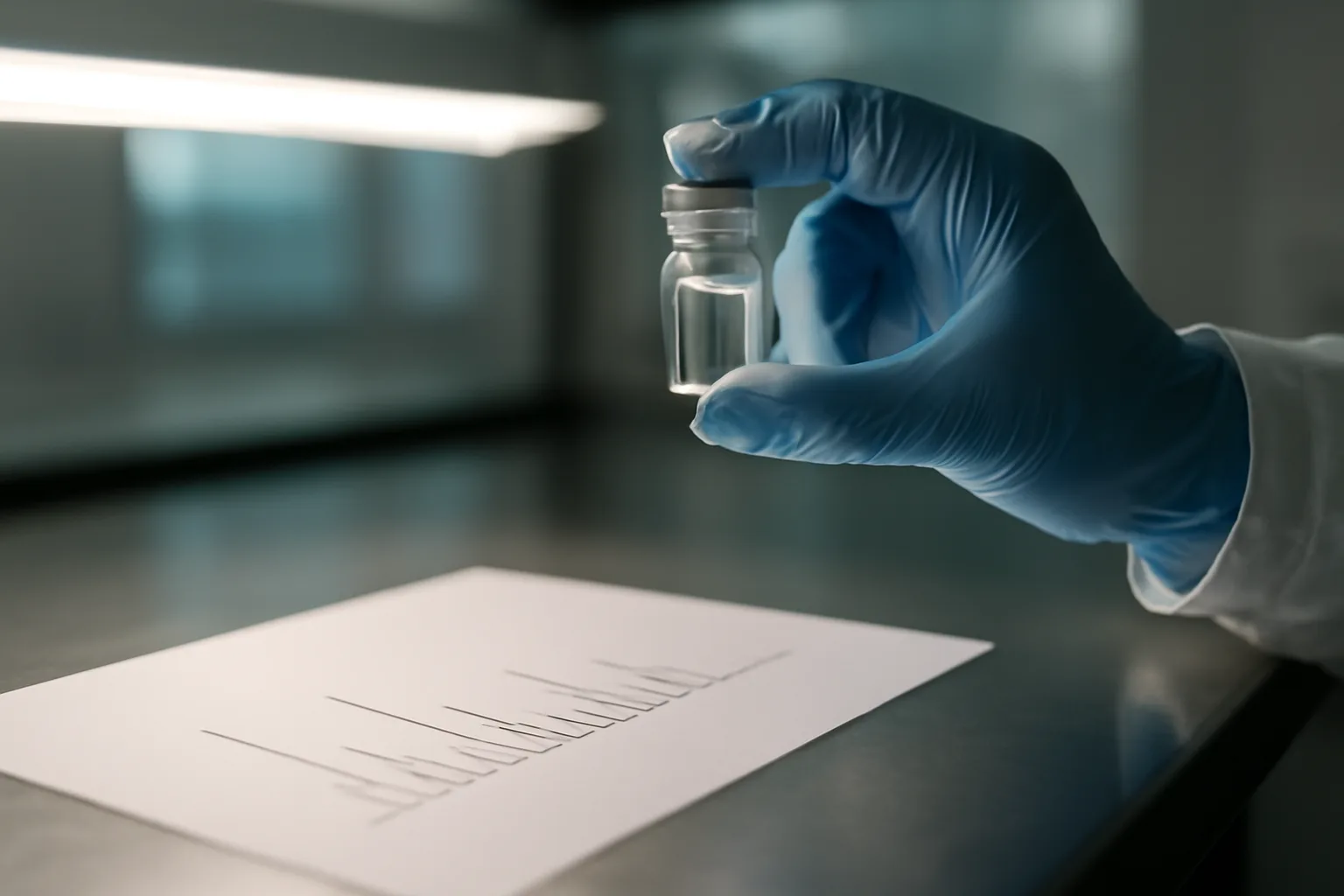
A COA is a lab report generated after testing a specific batch of material. For a peptide, a complete one should show the testing lab's name and accreditation, the lot or batch number tested, the date of testing, the HPLC purity result with a visible chromatogram (more than a stated number), and ideally a mass spectrometry result confirming the molecular weight matches the expected sequence. Here's the gap almost nobody talks about: HPLC purity and mass spec identity confirmation are not the same test as sterility or endotoxin testing. USP General Chapter <71> covers sterility testing and USP <85> covers bacterial endotoxin testing, both of which are separate analytical procedures from the identity/purity work done via HPLC [3]. A peptide vial can show 99% HPLC purity and still carry bacterial endotoxin above safe thresholds if it wasn't manufactured and packaged under controlled conditions. If a COA doesn't mention endotoxin testing (usually reported in EU/mL, endotoxin units per milliliter) at all, assume it wasn't done. A usable COA checklist: | Element | Why it matters | Red flag if missing |
Does a high purity percentage mean the product is safe to inject?
No. Purity percentage and safety are answering different questions, and conflating them is the single most common error in how these products get marketed. HPLC purity tells you how much of the detected material is the target peptide versus synthesis-related impurities (truncated chains, deletion sequences, oxidized residues). It says nothing about bioburden (bacterial contamination), endotoxin (bacterial cell wall remnants that survive even after the bacteria are dead), heavy metal residues from synthesis reagents, or residual solvents. A product can be 99% pure by HPLC and still be unsafe to inject if it was reconstituted or packaged in non-sterile conditions. This matters specifically for anything sold as "research use only," which describes essentially the entire online CJC-1295 market. There is no FDA-approved CJC-1295 product, and research-use-only material is explicitly not intended for human administration, which means it is also not held to the same manufacturing and testing standards as a pharmacy-dispensed drug. For a fuller picture of what this means for actual health risk, see CJC-1295 side effects.
How do I know a COA wasn't faked or copy-pasted?
Cross-check the lab, more than the document. A real, independent testing lab has a name, a physical location, and typically a searchable accreditation (ISO/IEC 17025 is the standard most contract labs cite for testing competence) [4]. If you can't find the lab anywhere outside the vendor's own website, that's a signal, not proof of fraud, but a signal. Match the lot number on the COA to the lot number printed on your vial. This sounds obvious and gets skipped constantly. Vendors sometimes post one COA from one batch that tested well, then sell multiple batches under that same posted document. If the lot numbers don't match, the COA is decorative. Look at the date. A COA from two years ago tells you nothing about a batch synthesized last month. Peptides degrade over time depending on storage conditions, and a testing date establishes when the sample was actually good, not an indefinite guarantee. Ask whether the lab tested a sample the vendor sent them, or whether an independent third party pulled the sample themselves. Vendor-submitted samples can be cherry-picked from the best portion of a batch. Third-party pulled samples, where an independent tester buys the product the same way a customer would and then tests it, are a meaningfully stronger form of evidence. This is rare in the peptide space but it's the standard worth asking for.
What's the difference between CJC-1295 and CJC-1295 with DAC, and does it change what I should test for?
CJC-1295 without DAC (sometimes sold as "modified GRF 1-29" or just "Mod GRF") is a 29-amino acid peptide with a short half-life, on the order of 30 minutes, because it's cleared like most unmodified peptides [2]. CJC-1295 with DAC adds a maleimide group that covalently binds to albumin in the bloodstream, dramatically slowing clearance. The original pharmacokinetic study describing this modification reported a half-life extending to several days, with the authors noting sustained GH and IGF-1 elevation over the dosing interval in the tested population [2]. This is not a purity distinction, but it changes what a legitimate COA needs to specify. The molecular weight is different between the two forms (DAC adds meaningful mass from the linker and albumin-binding domain), so a mass spec result that doesn't match the claimed form is an identity failure, not a purity nuance. If you're buying "no-DAC" CJC-1295, the COA's stated molecular weight should reflect the smaller, unmodified peptide. If you're buying the DAC version, it should reflect the larger conjugate. Dosing protocols also differ substantially by form because of the half-life difference, which is a separate but related reason to be certain which one you actually have. See CJC-1295 dosage and the DAC dosage calculator for how frequency assumptions change between the two.
Why is CJC-1295 almost always paired with ipamorelin, and does that affect testing?
CJC-1295 is a GHRH analogue, meaning it acts on the GHRH receptor to stimulate a pulse of growth hormone release. Ipamorelin is a ghrelin receptor agonist (a growth hormone secretagogue in the GHRP family), acting through a different receptor pathway. The rationale for combining them, which shows up constantly in peptide vendor marketing and some clinical pharmacology literature on combined GHRH/GHRP dosing, is that stimulating two separate receptor pathways at once can produce a larger acute GH pulse than either compound alone [5]. That rationale is mechanistically reasonable and has some support in older combined-secretagogue studies going back to the 1990s work on GHRP-6 and GHRH co-administration [5]. It is not the same as having a clinical trial showing that the CJC-1295/ipamorelin combination, specifically, improves a defined health outcome in a defined population over a defined time period. Most of what circulates about optimal ratios, injection timing relative to meals, and cycle length comes from bodybuilding forum consensus, not published trials. Treat that material as folklore worth being aware of, not as evidence. On testing specifically: if you're buying a pre-mixed "blend" vial containing both peptides, you now need a COA that verifies two separate identities and two separate purity numbers, plus confirmation that the stated ratio (commonly marketed as something like 2mg CJC-1295 to 2mg ipamorelin, though ratios vary by seller) actually matches what's in the vial. Blended vials are harder to verify than single-peptide vials because a single HPLC trace has to cleanly separate two different molecules, and sellers rarely publish that chromatogram.
What lab tests would actually confirm safety, more than identity?
A genuinely reassuring testing package for an injectable research peptide would include several distinct analyses, not one purity percentage: HPLC purity with a visible chromatogram, ideally above 98% by peak area, showing clean separation from impurity peaks. Mass spectrometry confirming the molecular weight matches the expected sequence within a tight tolerance. Sterility testing per a recognized method such as USP <71>, confirming no viable microbial growth in the sample [3]. Bacterial endotoxin testing per USP <85>, reported in EU/mL, since endotoxin survives even terminal sterilization and heat treatment [3]. Heavy metal and residual solvent screening, since peptide synthesis uses reagents (like trifluoroacetic acid and various coupling agents) that need to be washed out completely. In practice, almost no direct-to-consumer research peptide seller publishes all five. Most publish HPLC purity alone, some add mass spec, and sterility/endotoxin data is rare outside of pharmacy-grade compounding. That gap is exactly why sourcing through a pharmacy-reviewed channel, rather than an anonymous online peptide shop, changes the risk profile: compounding pharmacies operating under state board oversight are subject to USP <795>/<797> sterile and non-sterile compounding standards that most peptide-only vendors never touch .
Is CJC-1295 legal to buy, and does that affect quality control?
CJC-1295 is not FDA-approved for any human use and has no established prescribing information. It circulates almost entirely as a "research chemical" or through compounding pharmacies that prepare it pursuant to a practitioner's order. The FDA's compounding rules, under Section 503A and 503B of the Federal Food, Drug, and Cosmetic Act, govern what compounders can legally prepare and what quality standards apply, but those rules generally apply to compounding pharmacies, not to peptide-only ecommerce sellers who ship "research use only" vials. As FDA's guidance on 503A compounding states, the exemptions apply to drugs "compounded for an identified individual patient based on the receipt of a valid prescription," a description that does not fit bulk research-chemical sales . That legal gap is the whole reason purity and testing become a personal due-diligence problem instead of a regulatory guarantee. A pharmacy operating under 503A/503B oversight has inspection requirements, USP compounding standard obligations, and a state board tracking complaints. A standalone peptide website has none of that unless it chooses to publish real, verifiable third-party testing. This is the practical reason a provider-reviewed sourcing path matters more here than in most supplement categories: the paperwork trail (prescription, compounding pharmacy license, batch-specific COA) is the difference between a traceable product and an anonymous vial. CJC-1295 Co reviews providers along exactly this line and names the fulfilling pharmacy partner for orders placed through its reviewed route, rather than shipping product itself.
What are the most common purity and testing red flags to watch for?
A stock photo of a chromatogram instead of an actual lab-generated one specific to the lot you're buying. This is more common than it should be and is essentially unverifiable when it happens. A COA with no lot number, or a lot number that doesn't match the vial label. This is the single easiest thing to check and the most commonly skipped. Purity claims above 99% with no chromatogram or mass spec to back the number. Extremely high purity is achievable but should come with data, more than a printed percentage. No mention of DAC status when the product is simply labeled "CJC-1295." Given the molecular weight and half-life differences, this ambiguity alone should be disqualifying. A testing lab that can't be found anywhere except on the vendor's own site, with no accreditation number or verifiable address. COAs that are more than a year old being used to represent current inventory. Peptides degrade; a stale COA proves nothing about what's in stock today. No endotoxin or sterility data anywhere in the vendor's published materials, despite the product being marketed for injection.
How should I actually evaluate a CJC-1295 source before buying?
Start by requesting the COA directly and checking whether the lot number on the document matches what would ship to you. If a seller won't provide a lot-matched COA before purchase, that alone is disqualifying for anyone serious about verification. Search the testing lab independently. A few minutes confirming the lab exists, has an address, and ideally an ISO/IEC 17025 accreditation number is worth more than any purity percentage on the label [4]. Check whether DAC status is explicitly and correctly labeled, and whether the stated molecular weight in the mass spec data matches the form you think you're buying. Ask, in writing, whether sterility and endotoxin testing were performed, and if the answer is vague or unavailable, treat that as the default assumption: they weren't. Weigh the sourcing channel itself. A compounding pharmacy operating under state board oversight and USP <795>/<797> standards carries a fundamentally different accountability structure than an anonymous research-chemical storefront . For readers who want to skip the vial-by-vial detective work, the more defensible path is a provider-reviewed route where the fulfilling pharmacy is named and traceable, rather than an unnamed overseas lab. See CJC-1295 for sale for how sourcing options compare, and CJC-1295 for the underlying mechanism and evidence base before you buy anything.
Frequently asked questions
What does "98% pure" actually mean on a CJC-1295 COA?
It means that in the specific batch tested, 98% of the material detected by HPLC matched the target peptide's expected elution profile, with 2% being impurities like truncated or deamidated peptide fragments. It says nothing about sterility, endotoxin levels, or whether your vial matches the tested batch unless the lot numbers align.
Does a certificate of analysis (COA) prove the product is sterile?
No. A standard peptide COA usually reports HPLC purity and sometimes mass spectrometry identity, both separate from sterility testing (USP <71>) and endotoxin testing (USP <85>). Unless the COA explicitly lists sterility and endotoxin results, assume those tests were not performed.
What's the difference between CJC-1295 and CJC-1295 with DAC?
CJC-1295 without DAC is a short-half-life GHRH analogue (roughly 30 minutes). CJC-1295 with DAC has a linker that binds serum albumin, extending measured half-life to several days per the original pharmacology study. They are different molecules with different molecular weights, dosing frequencies, and COA identity requirements.
Why is CJC-1295 usually sold with ipamorelin?
CJC-1295 stimulates the GHRH receptor while ipamorelin activates the separate ghrelin receptor pathway. Combined GHRH/GHRP dosing has shown larger acute GH pulses in older pharmacology literature, but that's a mechanistic rationale, not proof of a specific clinical outcome from this exact combination.
Can a peptide be high purity and still unsafe to inject?
Yes. HPLC purity measures chemical composition, not microbial contamination or endotoxin content. A 99% pure sample by HPLC can still carry unsafe bacterial endotoxin levels if it wasn't manufactured and packaged under sterile, controlled conditions.
How do I check if a testing lab on a COA is legitimate?
Search for the lab's name and physical address independently of the vendor's website, and look for an ISO/IEC 17025 accreditation number, the standard most contract testing labs cite for competence. If the lab only appears on the seller's own materials with no verifiable outside presence, treat the COA with real skepticism.
Does the lot number on a COA actually matter?
Yes, it's the single most important check. A COA is only meaningful for the specific batch it was tested from. If the lot number on the document doesn't match the lot number printed on your vial, the COA proves nothing about what you're actually holding.
Is CJC-1295 FDA approved?
No. There is no FDA-approved CJC-1295 product for any human indication. It's sold either as a research chemical (research use only, not for human use) or prepared by compounding pharmacies under practitioner orders, which operate under separate federal compounding rules (FDCA Sections 503A/503B).
What's the safest way to source CJC-1295 given the lack of regulation?
Going through a provider-reviewed channel with a named, traceable compounding pharmacy is more defensible than buying from an anonymous research-chemical website, because pharmacies operate under state board oversight and USP compounding standards that most peptide-only sellers never follow.
How old can a COA be before it's meaningless?
There's no official cutoff, but a COA older than about a year tells you nothing about current inventory, since peptides degrade over time depending on storage conditions. Ask for testing performed on the specific batch you're buying, not an older reference document.
Do blended CJC-1295/ipamorelin vials need different testing than single-peptide vials?
Yes. A blend requires a COA that verifies two separate peptide identities, two purity numbers, and confirmation the stated ratio matches what's actually in the vial. A single HPLC trace has to cleanly separate both molecules, and that chromatogram is rarely published by sellers.
What impurities show up in a CJC-1295 HPLC trace?
Common impurities include truncated sequences (peptide chains that stopped forming early during synthesis), deletion or substitution variants, deamidated residues, and residual synthesis byproducts. A clean chromatogram shows one dominant, sharply defined peak with minimal shouldering or secondary peaks.
Sources
- Teichman et al., Journal of Clinical Endocrinology & Metabolism, 2006: CJC-1295 with DAC pharmacokinetics showing extended half-life and sustained GH/IGF-1 elevation
- U.S. Pharmacopeia General Chapter <1211> Sterility Assurance (referencing <71> Sterility Tests): Sterility testing (USP <71>) and bacterial endotoxin testing (USP <85>) are distinct procedures from identity/purity HPLC testing
- ANSI National Accreditation Board, ISO/IEC 17025:2017 General Requirements for Testing and Calibration Laboratories: ISO/IEC 17025 is the recognized accreditation standard for testing laboratory competence
- Bowers, C.Y., "Unnatural growth hormone-releasing peptide begets natural growth hormone-releasing hormone," Journal of Clinical Endocrinology & Metabolism, 1998 (PMID 9814575): Combined GHRH and GHRP administration produces larger acute growth hormone pulses than either compound alone
- U.S. Pharmacopeia General Chapter <797> Pharmaceutical Compounding, Sterile Preparations: Compounding pharmacies operate under USP sterile and non-sterile compounding standards not required of peptide-only sellers
- FDA, "Human Drug Compounding Under Section 503A of the FD&C Act," Guidance for Industry (October 2016): Federal compounding rules under FDCA 503A require a valid prescription for an identified individual patient, distinguishing licensed compounding pharmacies from research-chemical sellers