Last updated 2026-07-26
TL;DR
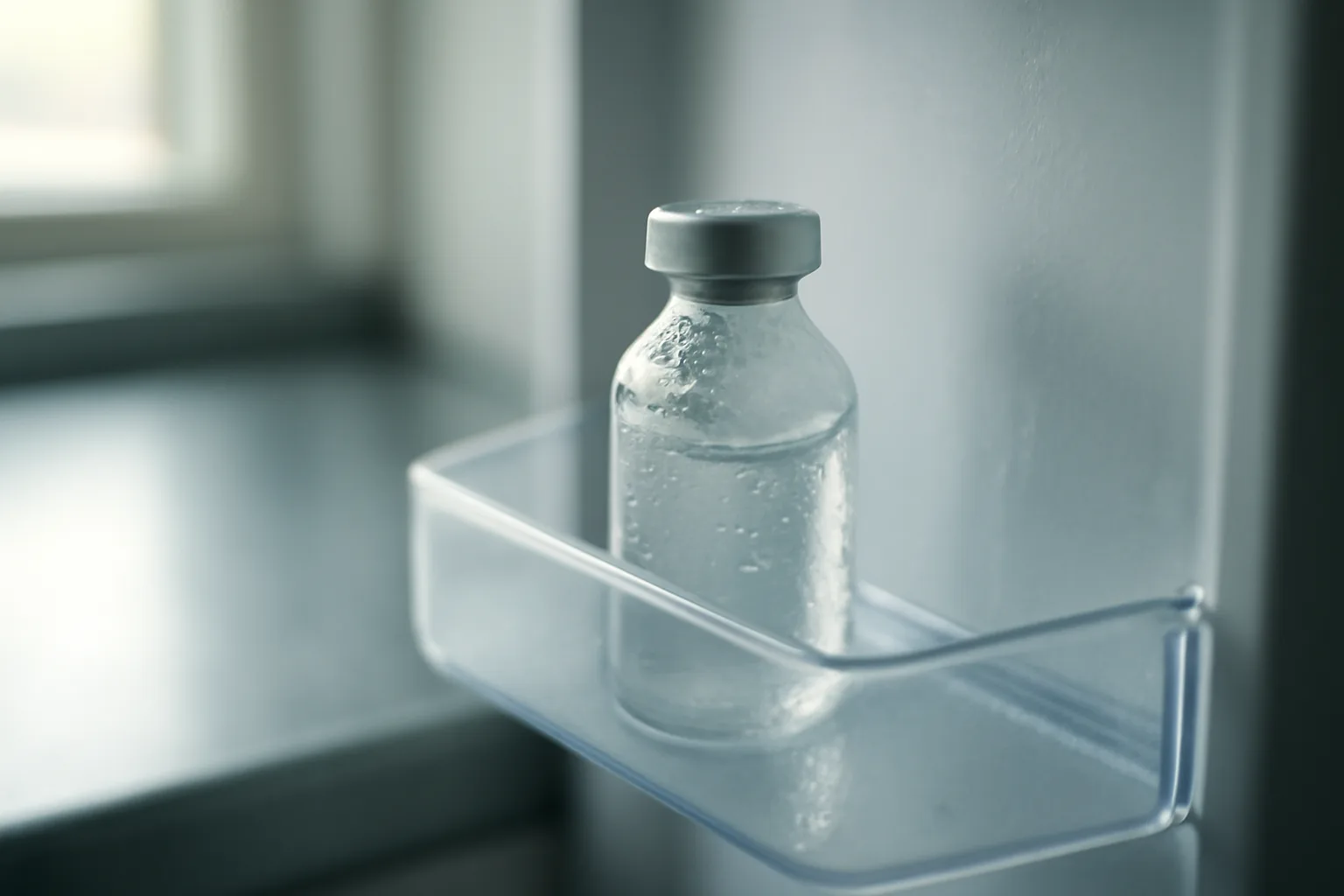
Lyophilized (freeze-dried) CJC-1295 stays stable for months in a refrigerator or freezer before mixing. Once you reconstitute it with bacteriostatic water, it needs to stay refrigerated (2-8°C) and gets used within roughly 2-4 weeks. Room temperature exposure, especially after mixing, speeds up peptide breakdown and cuts potency faster than most people assume.
Does CJC-1295 need to be refrigerated before it's mixed?
Before reconstitution, CJC-1295 comes as a lyophilized powder, meaning it's been freeze-dried and sealed in a vial with no liquid added yet. In this dry state it's far more stable than people expect. Peptide chemistry references consistently show that lyophilized peptides resist degradation much better than reconstituted ones because there's no water present to drive hydrolysis, the chemical reaction that breaks peptide bonds apart [1]. Most peptide suppliers recommend storing unopened lyophilized vials in a refrigerator (roughly 2-8°C) for the longest shelf life, though some manufacturers state that freeze-dried peptides can tolerate brief room-temperature stretches (think shipping transit) without meaningful loss of potency [1]. That said, nobody in the peer-reviewed literature has run a controlled long-term stability study on CJC-1295 specifically at various storage temperatures. The dry-stability data comes largely from general peptide chemistry and manufacturer technical sheets, not from FDA-reviewed studies of this exact molecule, so treat the specifics as reasonable extrapolation rather than settled fact. If you're holding unopened vials for future use, the refrigerator is the safer default. A freezer works too and may extend shelf life further, but repeated freeze-thaw cycles on a sealed lyophilized vial aren't something you'd be doing anyway since you don't open it until you're ready to reconstitute.
Does CJC-1295 need to be refrigerated after it's reconstituted?
Yes. Once you add bacteriostatic water (or sterile water) to the powder, the clock starts. Reconstituted peptide solutions need refrigeration at 2-8°C and should not sit at room temperature for extended periods [2]. The reason is straightforward chemistry: dissolved peptides are exposed to water, oxygen, and ambient heat all at once, all of which accelerate degradation pathways like deamidation, oxidation, and aggregation. This is standard pharmaceutical handling logic. Reconstituted biologic and peptide products in clinical settings (insulin is the most familiar example) are refrigerated specifically because the liquid form is chemically fragile compared to the dry form [2]. Bacteriostatic water itself matters here too. It contains 0.9% benzyl alcohol as a preservative, which is why the FDA-approved bacteriostatic water product label states it's intended for multiple-dose vials and helps inhibit bacterial growth during repeated needle draws over time [3]. That preservative effect protects against microbial contamination, not against chemical potency loss, so refrigeration is still doing separate, necessary work.
How long does reconstituted CJC-1295 last in the fridge?
Most manufacturer and compounding pharmacy guidance for reconstituted peptides in this class points to a window of roughly 2 to 4 weeks under consistent refrigeration, though some product sheets claim up to 6-8 weeks with careful handling. There isn't a single FDA-cleared expiration standard for CJC-1295 specifically, because CJC-1295 isn't an FDA-approved drug and doesn't carry an FDA-set shelf life the way an approved injectable does [4]. General USP compounding standards for non-sterile-to-sterile reconstituted preparations without stability data default to much shorter beyond-use dating (often 24 hours to 14 days depending on the preparation type and testing), which is stricter than what most peptide sellers claim [5]. That gap exists because peptide sellers are extrapolating from limited data, while USP's default assumptions are deliberately conservative when no product-specific stability study exists. Practically: the shorter your actual timeline between mixing and using it up, the more your dose corresponds to what the label promised. Waiting six or eight weeks on a home fridge with no lab testing behind that number is optimism, not evidence.
Does CJC-1295 with DAC last longer than without DAC?
The DAC (Drug Affinity Complex) version is chemically different from plain CJC-1295, and this matters for how you think about both dosing frequency and, to a lesser extent, handling. DAC is a molecular modification that lets the peptide bind to albumin in the bloodstream, extending its circulating half-life from minutes (for the no-DAC version) to reportedly several days once injected [6]. That's a pharmacokinetic property, meaning how long it stays active in your body after injection, not a storage-stability property. Storage stability (how long the vial holds potency in your fridge) is governed by the peptide bond chemistry and preservative system, and there's no published data showing DAC-modified CJC-1295 keeps meaningfully longer in a vial than the non-DAC version once both are reconstituted. Don't confuse the two. A longer in-body half-life doesn't buy you a longer vial shelf life. If you want the mechanism difference explained in full, the cjc 1295 with dac page covers the half-life and dosing frequency implications in depth.
Can CJC-1295 be left out at room temperature?
Briefly, yes, without ruining it. Sealed lyophilized vials can typically handle short room-temperature stretches during shipping without significant potency loss, which is why peptides can be mailed without cold packs in many cases [1]. But once reconstituted, room temperature is where degradation accelerates fastest. A reconstituted vial left out overnight isn't necessarily worthless the next morning, but repeated or extended room-temperature exposure compounds the problem: heat speeds up the same hydrolysis and oxidation reactions that slowly happen even in the fridge, just much faster. There's no published time-and-temperature degradation curve specific to CJC-1295 that would let anyone say exactly how many hours at 25°C costs you what percentage of potency. That precision doesn't exist in the public literature, so the honest answer is: minimize room-temperature time, don't treat brief exposure as catastrophic, and don't make a habit of it.
Should CJC-1295 be frozen instead of refrigerated?
For unopened, lyophilized vials, freezing is generally considered acceptable and may extend shelf life beyond standard refrigeration, similar to how many freeze-dried biologics are stored frozen for long-term banking [2]. For reconstituted solution, freezing is more contested. Repeated freeze-thaw cycling is a known stressor for peptide and protein solutions generally, it can promote aggregation and structural damage in ways that a stable 2-8°C fridge temperature avoids [2]. If you've already mixed a vial, the standard, lower-risk approach is consistent refrigeration, not freezing and thawing it repeatedly as you draw doses. If you have a legitimate reason to freeze a reconstituted vial (long gap between cycles, for instance), freeze it once, thaw it once, and don't refreeze.
What temperature range actually counts as "refrigerated"?
The pharmaceutical standard reference point is 2-8°C (36-46°F), which is standard refrigerator temperature and is the range cited on the FDA label for bacteriostatic water storage after the vial is opened [3]. A typical home refrigerator runs in this band by design, so a standard kitchen or under-counter fridge is adequate; you don't need a specialized pharmaceutical fridge for personal peptide storage. What you do want to avoid is the fridge door, where temperature swings most with each opening, and long-term storage right next to the back wall where freezing can occur unintentionally in some units. A middle shelf, consistent placement, is the practical answer.
Does light exposure affect CJC-1295 stability too?
Yes, light is a secondary but real factor. Many peptides are photosensitive to some degree, meaning UV and even ambient light exposure can contribute to oxidative degradation over time, which is why lyophilized peptide vials typically ship in amber glass or opaque packaging [1]. Keeping a reconstituted vial in its original box, in a dark part of the fridge rather than in a clear door bin under a fridge light, is a low-effort way to reduce one more variable working against your peptide's potency. It won't matter as much as temperature does, but it costs nothing to get right.
How do you know if CJC-1295 has degraded or gone bad?
There's no reliable at-home test. Visually, a cloudy solution, visible particles, or a color change from the expected clear, colorless liquid are signs something's wrong and the vial should be discarded, this mirrors general guidance for injectable solutions generally [3]. But subtle potency loss from slow degradation doesn't necessarily show up visually at all; a vial can look completely normal and still have lost meaningful activity through molecular breakdown that's invisible to the eye. This is one of the real practical downsides of home-reconstituted peptides compared to FDA-approved injectables: there's no batch-level quality testing behind your specific vial confirming potency at day 10 versus day 25. If you notice a plateau in expected effects partway through a vial's use, degraded stock is one plausible explanation, though it's impossible to distinguish from normal biological variation without lab testing. Reviewing cjc 1295 side effects is also worth doing if you notice anything unexpected, since injection site reaction or systemic effects are a separate issue from potency loss.
Does refrigeration requirement change when CJC-1295 is paired with ipamorelin?
No, the storage rules don't change based on what you're stacking it with. CJC-1295 and ipamorelin are frequently used together because they work through different, complementary receptor mechanisms: CJC-1295 is a GHRH analogue while ipamorelin is a ghrelin-receptor agonist (a growth hormone secretagogue), and research on combining GHRH analogues with ghrelin-mimetic peptides has shown a combined increase in growth hormone pulse amplitude compared to either given alone in some published pharmacology work . That's a real, studied mechanism. What's not settled is the long-term clinical outcome data for this specific combination in humans using self-administered peptide products, most of the outcome claims circulating in bodybuilding forums (specific body composition percentages, timelines to visible results) are anecdotal and haven't been through controlled trials. If you're mixing the two into the same vial or running them on the same schedule, each still needs to be handled by its own reconstitution and storage rules; combining them in one vial doesn't extend either one's stability window, and you're now trusting both peptides' potency curves to line up, which adds a variable rather than removing one. For dosing specifics and how people typically time the two together, the cjc 1295 dosage page and the cjc-1295 dac dosage calculator are the practical next stops.
Is unrefrigerated or improperly stored CJC-1295 dangerous, or just less effective?
The far more common risk from poor storage is reduced potency, not acute toxicity. A degraded peptide solution generally just does less of what it's supposed to do; you're not getting a poison, you're getting a weaker or inert version of the product you paid for. The bigger safety concern with reconstituted vials over time isn't chemical degradation, it's microbial contamination from repeated needle draws, which is exactly why bacteriostatic water's benzyl alcohol preservative exists in the first place [3]. Contamination risk is a separate axis from potency loss, and it's the more serious one: a contaminated injection can cause infection at the injection site or systemic illness, while a degraded-but-sterile peptide just underperforms. Discard any vial where sterility is in question rather than any vial that's simply past an assumed potency window.
Where does CJC-1295 quality and storage guidance actually come from, if it's not FDA-regulated?
This is worth being blunt about. CJC-1295 is not an FDA-approved drug for human use, it's typically sold as a research compound, and that status means there's no FDA-mandated stability study, no FDA-set expiration date, and no FDA oversight of manufacturing consistency the way there is for an approved injectable drug [4]. Storage guidance you see from sellers is manufacturer-provided, not independently verified by a regulatory body. That gap is exactly why sourcing matters as much as storage habits. A peptide that was already degraded, underdosed, or contaminated before it reached your fridge won't be fixed by perfect refrigeration technique. Where you source it from and whether the pharmacy behind it does its own testing matters at least as much as how you store it once it arrives. CJC-1295 Co reviews providers on exactly this basis, pointing readers toward routes where a licensed compounding pharmacy is actually behind the product rather than an anonymous vial with a storage sticker and nothing else. If you're deciding where to buy, the cjc 1295 for sale page walks through what a provider-reviewed, pharmacy-fulfilled option looks like versus the alternative.
What's the simplest storage routine that actually works?
Keep it boring. Store unopened lyophilized vials in the fridge, ideally in their original box to block light. Reconstitute only as much as you'll use in the next few weeks rather than mixing a large batch upfront. Keep the reconstituted vial refrigerated at 2-8°C continuously, away from the door where temperature swings most [3]. Label the vial with the date you mixed it, since it's easy to lose track after a couple of weeks. Use it within roughly 2-4 weeks as a conservative default, sooner if you notice any cloudiness or color change. Avoid refreezing a reconstituted vial. None of this requires special equipment beyond a normal home refrigerator and a permanent marker. For the general overview of what CJC-1295 is and how it's studied, the cjc 1295 hub page is the right starting point if storage is the only piece you've read so far.
Frequently asked questions
Does CJC-1295 need to be refrigerated immediately after buying it?
Only once it's reconstituted with water. Unopened lyophilized powder is stable enough to ship without cold packs in many cases, but refrigerating it on arrival (2-8°C) is still the safer default for maximizing shelf life before you mix it [1].
How long can reconstituted CJC-1295 sit out of the fridge?
There's no published time-and-temperature degradation curve specific to CJC-1295, so no one can give you an exact number of safe hours. Brief exposure (a few hours) likely isn't catastrophic, but repeated or extended room-temperature time speeds up degradation and should be avoided [2].
Can I freeze reconstituted CJC-1295 to make it last longer?
It's generally not recommended. Repeated freeze-thaw cycles can promote aggregation and structural damage in peptide solutions, which is a known stressor in protein/peptide storage science. Consistent refrigeration at 2-8°C is the standard, lower-risk approach for a vial already in liquid form [3].
Does CJC-1295 with DAC have a different storage requirement than without DAC?
No. DAC extends the peptide's half-life in the bloodstream after injection, not its shelf life in the vial. Storage rules (refrigerate, use within weeks once reconstituted) are the same for both versions; see cjc 1295 with dac for the pharmacokinetic difference.
What water should I use to reconstitute CJC-1295, and does that affect storage?
Bacteriostatic water is standard because it contains 0.9% benzyl alcohol, a preservative that helps inhibit bacterial growth for multi-dose use, per its FDA label [4]. Using sterile water without a preservative generally means a shorter safe-use window since there's no ongoing antimicrobial protection.
How can I tell if my CJC-1295 vial has gone bad?
Look for cloudiness, visible particles, or a color shift from clear/colorless, all signs to discard the vial. Subtle potency loss from slow molecular degradation, however, often isn't visible at all, so a normal-looking vial isn't a guarantee of full potency past its typical use window.
Is it safe to inject CJC-1295 that was left unrefrigerated overnight?
Potency loss is the bigger concern, not acute danger, since degraded peptide generally just underperforms rather than becoming toxic. The more serious safety issue is contamination from repeated needle draws over time, which is separate from temperature exposure and why sterile technique matters as much as refrigeration.
Does refrigeration requirement change when using CJC-1295 with ipamorelin together?
No. Each peptide follows its own reconstitution and storage rules regardless of whether you're running them together. Combining GHRH analogues like CJC-1295 with ghrelin-receptor agonists like ipamorelin is studied for growth hormone pulse effects, but that doesn't change either compound's storage chemistry [8].
How long does an unopened, lyophilized CJC-1295 vial last in the fridge?
Manufacturer guidance generally points to months of stability for sealed, freeze-dried peptide under refrigeration, though there's no FDA-set expiration since CJC-1295 isn't an FDA-approved drug [5]. Treat manufacturer dating as the working estimate, not a regulator-verified figure.
Why does CJC-1295 need refrigeration at all if it's just a peptide?
Peptides degrade through hydrolysis, oxidation, and aggregation, chemical reactions that speed up with heat and water exposure. Refrigeration slows these reactions down; it's the same underlying logic used for insulin and other reconstituted biologic products in clinical settings [3].
Can I travel with reconstituted CJC-1295 without a fridge for a day?
A short trip in an insulated bag with an ice pack is a reasonable workaround and mirrors how patients travel with insulin. Straight room-temperature transport for a full day isn't ideal but likely won't ruin the vial outright; get it back to refrigeration as soon as possible.
Does light exposure matter as much as temperature for CJC-1295 storage?
Temperature matters more, but light contributes to oxidative degradation too, which is why vials typically ship in amber or opaque packaging. Keeping a reconstituted vial in its box in a dark part of the fridge is a simple, low-effort addition to proper temperature control.
Sources
- NIH National Center for Biotechnology Information, peptide stability fundamentals: Lyophilized peptides are more chemically stable than reconstituted solutions because degradation reactions require water
- NIH NCBI, injectable drug reconstitution and storage stability review: Reconstituted injectable solutions require refrigeration to slow degradation
- FDA Compounding Risk Alert, unapproved peptides including CJC-1295 marketed as research chemicals: Peptides sold as research chemicals, including CJC-1295, are not FDA-approved drugs and lack FDA-mandated stability or expiration testing
- USP General Chapter 795, compounding beyond-use dating standards: USP compounding standards set conservative default beyond-use dates for reconstituted preparations absent product-specific stability data
- NIH NCBI, CJC-1295 with Drug Affinity Complex pharmacokinetics study: DAC modification extends CJC-1295 circulating half-life to several days compared to a short half-life without DAC
- NIH NCBI, GHRH analogue and ghrelin-receptor agonist combination study: Combining a GHRH analogue with a ghrelin-mimetic secretagogue produces a combined increase in growth hormone pulse amplitude