Last updated 2026-07-30
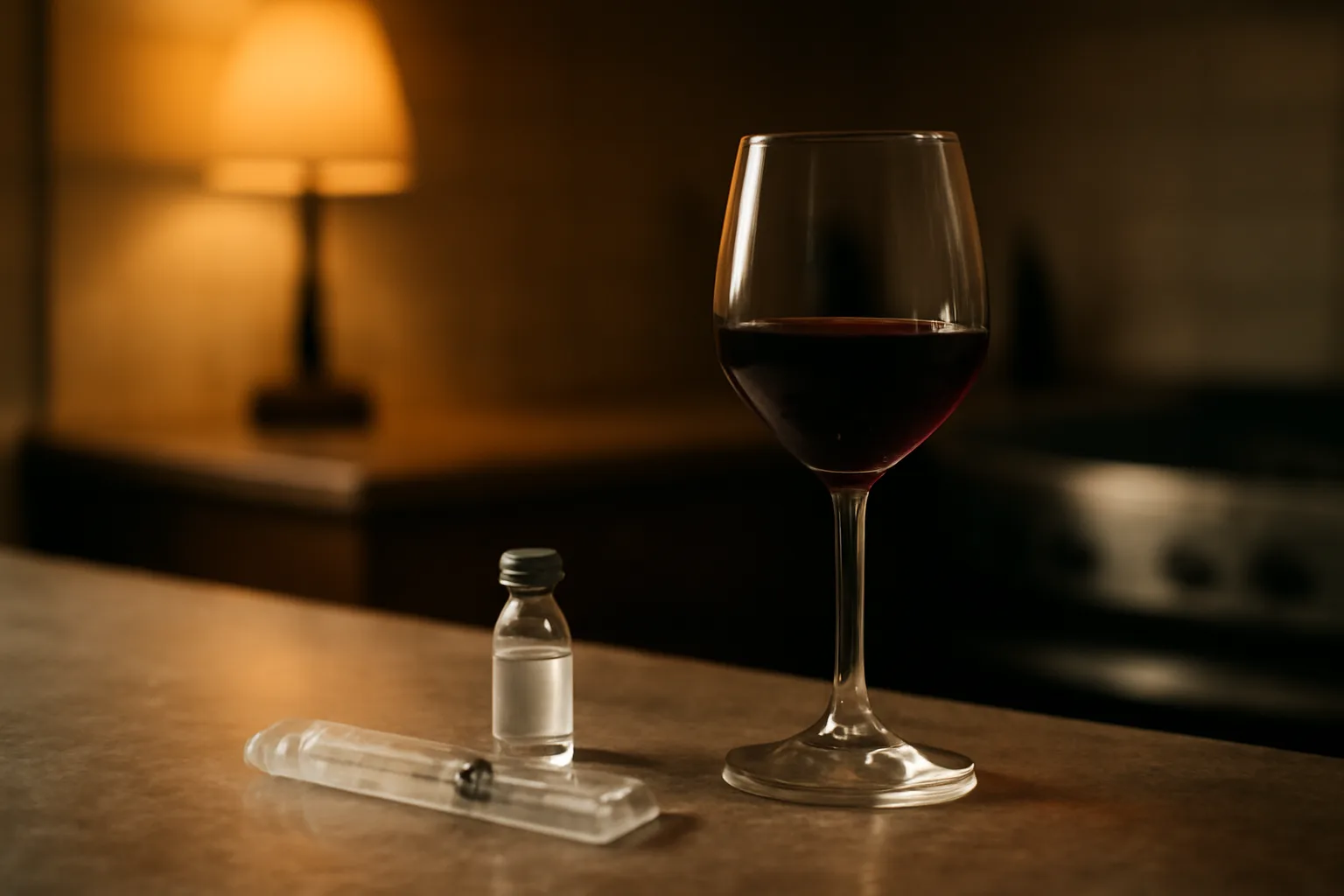
TL;DR
There's no clinical study on CJC-1295 combined with alcohol. What's known: alcohol suppresses natural growth hormone pulses by up to 50-70% in some studies, impairs the deep sleep where GH release peaks, and adds liver workload alongside a peptide that's usually injected, not drunk or eaten. The practical answer is to space them out and not treat this as a settled safety question, because it isn't one.
Does alcohol cancel out CJC-1295?
Nobody has run a trial mixing CJC-1295 with alcohol, so anyone giving you a precise percentage is guessing. What we do have is decades of research on alcohol and natural growth hormone secretion, and it's not encouraging. A frequently cited study in Alcoholism: Clinical and Experimental Research found that alcohol given in the evening suppressed nocturnal growth hormone release, with the effect tied to disruption of slow-wave sleep [1]. Since GH is released in pulses that are heavily concentrated during deep sleep, anything that fragments that sleep architecture blunts the pulse, regardless of what's driving the pulse in the first place. CJC-1295 works upstream of that pulse. It's a growth-hormone-releasing hormone (GHRH) analogue, meaning it signals the pituitary to release GH, it doesn't manufacture GH itself [2]. If alcohol is interfering with the sleep-stage machinery that GH release depends on, it's reasonable to think it blunts the response to CJC-1295 too, even though nobody has measured that specific combination in a lab. That's an inference from adjacent data, not a proven number, and you should treat it that way. The honest summary: alcohol probably doesn't neutralize CJC-1295 the way, say, taking it with food might slow subcutaneous absorption. It more likely undercuts the natural GH pulse that CJC-1295 is trying to amplify, by wrecking the sleep stage where that pulse normally lands.
How does alcohol affect growth hormone release on its own?
Alcohol's effect on GH is dose-dependent and tied closely to sleep quality, more than blood alcohol level at the moment of the pulse. Older endocrine literature going back to the 1970s and 1980s established that acute alcohol intoxication can blunt GH response to provocative stimuli like arginine or insulin-induced hypoglycemia, and that chronic heavy drinking is associated with lower baseline GH and IGF-1 in some populations, partly via liver dysfunction since IGF-1 is made in the liver [3]. Separately, sleep researchers have shown that alcohol taken before bed reduces slow-wave sleep in the second half of the night even as it can shorten sleep onset time, and slow-wave sleep is when the largest spontaneous GH pulse of the day happens in healthy adults [1]. Put together: even one evening drinking session timed near bedtime is more likely to blunt the night's GH pulse than a moderate lunchtime drink hours before sleep. Amount and timing both matter, and neither has been formally studied with a GHRH analogue on board.
Is it dangerous to drink alcohol while using CJC-1295?
There's no documented case of a dangerous drug interaction between CJC-1295 and alcohol in the medical literature, because the combination hasn't been studied as a specific safety question. That's different from saying it's been proven safe. The more grounded safety framing is liver load. CJC-1295 itself isn't hepatotoxic in the way some oral compounds are; it's a peptide typically given by subcutaneous injection, so it bypasses first-pass liver metabolism the way an oral drug wouldn't. Alcohol, on the other hand, is metabolized almost entirely in the liver, and heavy or chronic use is a well-established cause of liver injury, per the National Institute on Alcohol Abuse and Alcoholism [4]. If someone is combining CJC-1295 with other injectables, oral SARMs, or supplements that do carry liver risk, alcohol on top of that stack raises the cumulative burden on the liver even if CJC-1295 itself isn't the direct culprit. The more common real-world issue isn't organ damage, it's site-injection judgment. Alcohol impairs coordination and decision-making, and subcutaneous injections require a clean, steady, sober hand for site prep and technique. Injecting after drinking raises the odds of a sloppy injection, missed sterile technique, or picking the wrong site, which matters more practically for most users than any theoretical peptide-alcohol interaction.
Should I skip CJC-1295 the night I'm drinking?
Most people running CJC-1295 dose it in the evening, often before bed, specifically to align with the natural nocturnal GH pulse. That's also exactly when alcohol does the most damage to GH-relevant sleep architecture. A workable, conservative approach is to separate the two by several hours rather than co-administering. If you know you're drinking that evening, either take your dose well before you start drinking and well before you'd normally sleep, or skip that night's dose and resume the next day. Neither option is backed by a specific study proving it protects the GH pulse; it's just a common-sense way to reduce the overlap between a known GH-suppressing behavior and a compound whose entire mechanism depends on an intact pulse. Skipping occasional doses around a night out isn't going to meaningfully change outcomes over a multi-month protocol. The bigger risk to results is chronic heavy drinking on a regular schedule that consistently degrades sleep quality across the weeks you're running the peptide, not a single missed or adjusted dose.
Does CJC-1295 with DAC change any of this?
| Half-life | ~30 minutes | ~6-8 days [5] | |
|---|---|---|---|
| Dosing frequency | 1-2x daily | Weekly (or less) | |
| GH pattern | Discrete pulses | Sustained elevation | |
| Alcohol timing relevance | High (time around one dose) | Low (drug is always active) | Neither version has published human trial data on concurrent alcohol use. The distinction above is about drug kinetics, not a claim that one version is safer with alcohol; it isn't established either way. |
Yes, timing logic shifts depending on which version you're using, and this is one of the most commonly confused points in CJC-1295 discussion. CJC-1295 without DAC (sometimes called mod GRF 1-29) has a short half-life, on the order of 30 minutes, and is meant to be dosed once or twice daily, timed around meals and sleep to produce discrete GH pulses [2]. CJC-1295 with DAC (Drug Affinity Complex) binds to serum albumin and extends its half-life to roughly 6 to 8 days, which means it's dosed far less often, sometimes once weekly, and it produces a sustained elevation in GH and IGF-1 rather than a series of clean pulses [5]. That difference matters for the alcohol question. With no-DAC CJC-1295, timing a dose around a single evening of drinking is straightforward: you're managing one pulse. With DAC CJC-1295, the drug is active in your system continuously for most of a week, so there's no clean way to "time around" a single drinking occasion. Occasional moderate drinking is diluted across a much longer window of drug exposure; regular heavy drinking during a DAC cycle means you're layering chronic alcohol effects on top of a sustained IGF-1 elevation for the entire week, every week. | Feature | CJC-1295 no-DAC | CJC-1295 with DAC |
Can alcohol affect IGF-1 levels the way it affects GH?
IGF-1 is made mostly in the liver in response to GH signaling, so anything that impairs liver function has the potential to blunt IGF-1 production even if GH release itself is intact. Research on people with alcohol-related liver disease shows reduced IGF-1 levels that track with the severity of liver impairment, and some studies describe this as partial GH resistance, meaning the liver responds less to a given amount of circulating GH [3]. That's a picture built mostly from heavy, chronic drinkers and people with diagnosed liver disease, not casual or moderate drinkers, so it doesn't tell you what one or two drinks a week does to IGF-1 in an otherwise healthy person running CJC-1295. The reasonable read: occasional moderate drinking in someone with normal liver function is unlikely to meaningfully suppress IGF-1 production. Regular heavy drinking is a different story, and it's the kind of thing that would blunt the benefit you're paying for with any GH secretagogue, CJC-1295 included.
Why is CJC-1295 usually paired with ipamorelin, and does alcohol affect that combination differently?
CJC-1295 and ipamorelin are usually stacked because they work through different receptor pathways that both converge on GH release, which in theory produces a bigger pulse than either compound alone. CJC-1295 is a GHRH analogue acting on the GHRH receptor; ipamorelin is a ghrelin receptor agonist (a GH secretagogue in the growth hormone releasing peptide family) that acts through a separate pathway and is noted for being more selective, with less effect on cortisol and prolactin compared to older secretagogues like GHRP-6 [6] [7]. The rationale for stacking them is mechanistic and reasonably well grounded in receptor pharmacology: two different signals converging on the same pituitary somatotroph cells can produce a synergistic GH pulse, which is the same logic used in older clinical research combining GHRH with GHRP-class peptides in controlled settings [7]. What hasn't been shown in human trials is a specific, quantified outcome benefit from the CJC-1295/ipamorelin combination as sold and dosed in the peptide community, at the doses and schedules typically used. Most of the specific numbers people quote about this stack (percentage increases in GH, fat loss timelines, and so on) trace back to bodybuilding forums and marketing copy, not peer-reviewed trials on this exact pairing. On alcohol specifically: there's no separate data suggesting ipamorelin changes the alcohol-GH interaction one way or the other. If alcohol is blunting the sleep-stage GH pulse, it's blunting the pulse that both CJC-1295 and ipamorelin are trying to amplify, since both ultimately act on the same pituitary output. Adding ipamorelin doesn't give you a workaround for alcohol's effect on sleep architecture.
What does the research actually say versus what's bodybuilding forum folklore?
This is worth separating clearly, because a lot of what circulates about CJC-1295 and alcohol didn't come from a study; it came from someone's post. What's actually studied: alcohol's suppression of nocturnal GH pulses tied to slow-wave sleep disruption [1], the basic pharmacokinetics of GHRH analogues including CJC-1295's half-life with and without DAC [2] [5], reduced IGF-1 in chronic heavy drinkers with liver impairment [3], and the receptor mechanism and selectivity profile of ipamorelin versus older GH secretagogues [6] [7]. What's folklore: specific numbers like "alcohol cuts your CJC-1295 results by 50%," claims that a single beer "blocks" the peptide entirely, or timing windows presented as precise ("never drink within 72 hours") without a cited source. These numbers get repeated because they sound authoritative, not because someone measured them. If you see a specific percentage attached to "CJC-1295 and alcohol" without a named study behind it, treat it as forum lore, not evidence. For a broader look at what's actually been measured versus what's anecdotal across CJC-1295 use generally, see cjc-1295 reviews and cjc-1295 pros and cons.
Does moderate drinking ruin CJC-1295 results, or is it just heavy drinking that matters?
The dose-response relationship here almost certainly isn't a cliff edge. Physiology rarely works that way. A single moderate drink, taken hours before bed and well clear of an injection, is a small perturbation against a multi-week or multi-month protocol. Chronic heavy drinking, several drinks most nights, close to bedtime, over the same stretch of weeks you're running CJC-1295, is a different category entirely: it's sustained sleep disruption plus a plausible hit to liver-driven IGF-1 production plus general health decline, all stacked on top of each other for the full length of the protocol. If you're tracking outcomes, the confound to worry about isn't "did I have wine with dinner last Tuesday." It's whether your average sleep quality and average weekly drinking pattern across the whole cycle are good enough to let the GH pulse do its job. That's a harder thing to self-audit than a single night's choice, but it's the more honest variable. For people trying to gauge whether the protocol is working at all, cjc-1295 results timeline and cjc-1295 success rate cover what a realistic response curve looks like, separate from the alcohol question.
What should I actually do if I want to drink and still use CJC-1295 responsibly?
A few practical, low-risk habits, none of which require abstaining entirely, just some spacing and judgment. First, keep injections and drinking separated in time; don't inject right after or right before drinking, both for the sleep-architecture reason above and for basic injection-site hygiene and coordination. Second, if you know a night of heavier drinking is coming, it's reasonable to skip that day's dose rather than force it in; missing one dose in a multi-week protocol isn't going to derail outcomes. Third, keep the drinking itself moderate and infrequent if GH-axis outcomes actually matter to you, since chronic heavy alcohol use is the pattern with real evidence behind it, not occasional light use [1] [3] [4]. If you're sourcing CJC-1295 at all, this is also where working with a provider-reviewed pathway matters more than people expect; dosing guidance that accounts for real-world habits like alcohol use is part of what separates a properly reviewed protocol from a generic forum dosing chart. CJC-1295 Co's provider-reviewed listings are built around this kind of practical guidance, with orders fulfilled through a licensed pharmacy partner rather than an unregulated seller.
Bottom line: what's the actual answer here?
There is no published study measuring CJC-1295 combined with alcohol, so any precise claim about percentage loss of effectiveness is not real data, it's guesswork dressed up as a number. What is real: alcohol suppresses the nocturnal GH pulse by disrupting slow-wave sleep [1], chronic heavy drinking is linked to lower IGF-1 via liver impairment [3], and CJC-1295's entire mechanism depends on an intact pituitary GH pulse that alcohol is known to blunt through sleep disruption. The prudent, evidence-adjacent approach is to space doses away from drinking occasions, keep drinking moderate and infrequent if you care about GH-axis outcomes, and not fall for specific numbers that nobody has actually measured. For a fuller picture of what CJC-1295 does and doesn't reliably deliver, is cjc-1295 worth it and cjc-1295 before and after are good next reads.
Frequently asked questions
Can I drink alcohol the same day I take CJC-1295?
There's no rule against it and no study showing a specific danger, but timing matters. Alcohol close to bedtime disrupts the deep sleep stage where the natural GH pulse CJC-1295 amplifies actually happens [1]. Spacing your dose and your drinking apart by several hours is a reasonable, low-effort precaution, even without a study proving an exact safe window.
Does alcohol reduce growth hormone levels?
Yes, evening alcohol intake has been shown to suppress nocturnal GH secretion, an effect linked to reduced slow-wave sleep [1]. Chronic heavy drinking is also associated with lower IGF-1 in people with alcohol-related liver impairment, partly because IGF-1 is produced in the liver in response to GH signaling [3][7].
Is CJC-1295 hard on the liver like alcohol is?
No. CJC-1295 is a peptide typically given by subcutaneous injection, so it doesn't undergo the first-pass liver metabolism that oral drugs and alcohol do. It isn't documented as hepatotoxic. The liver concern with alcohol is about alcohol's own well-established metabolic burden on the liver, not something CJC-1295 causes directly [4].
Does the DAC version of CJC-1295 interact with alcohol differently than the non-DAC version?
The drug kinetics differ a lot, though neither has direct alcohol interaction data. No-DAC CJC-1295 has a roughly 30-minute half-life and produces discrete pulses you can time around a drinking occasion. DAC CJC-1295 has a 6-8 day half-life [5][6], staying active continuously, so there's no way to isolate a single night's drinking from ongoing drug exposure.
Will one beer or glass of wine ruin my CJC-1295 results?
Almost certainly not in any measurable way. The evidence points to chronic, heavy drinking patterns as the concern, via sleep disruption and liver-linked IGF-1 suppression [1][3]. A single moderate drink, especially taken well before bedtime, is a minor blip against a multi-week protocol, not a cliff-edge failure point.
Why do people pair CJC-1295 with ipamorelin instead of using either alone?
They act on different receptors, CJC-1295 on the GHRH receptor and ipamorelin on the ghrelin receptor, and combining GHRH-class and ghrelin-receptor-class secretagogues has shown synergistic GH release in controlled research settings [8][9]. That's a mechanistic rationale, not proof of a specific clinical outcome from the exact stack as commonly dosed.
Does alcohol affect ipamorelin the same way it affects CJC-1295?
There's no dedicated study on either compound combined with alcohol. Since both ultimately drive GH release through the same pituitary cells, and alcohol's main documented effect is on the sleep-stage GH pulse [1], it's reasonable to think alcohol blunts the benefit of both similarly, not that one is protected and the other isn't.
Should I skip my CJC-1295 dose entirely if I'm going to drink that night?
That's a reasonable, conservative choice if you're drinking heavily or late in the evening. Missing a single dose in a multi-week protocol won't meaningfully change outcomes. It's a simpler approach than trying to guess a safe gap in hours between drinking and injecting.
Can heavy chronic drinking cause GH resistance?
Research in people with alcohol-related liver disease describes reduced IGF-1 alongside intact or elevated GH levels, a pattern some researchers call partial GH resistance at the liver level [3][7]. This has mainly been documented in chronic heavy drinkers with diagnosed liver impairment, not in casual or moderate drinkers.
Is there any official warning about mixing CJC-1295 with alcohol?
No. CJC-1295 isn't FDA-approved for any indication and doesn't carry official prescribing information or an alcohol interaction warning the way an approved drug would. Any specific claim about a percentage effectiveness loss from mixing the two is not sourced to a real study.
How long should I wait between drinking and injecting CJC-1295?
There's no studied safe interval, so any specific number of hours is a guideline, not a proven threshold. A practical approach is to keep drinking and dosing on opposite sides of your day, avoid injecting while impaired for basic technique and hygiene reasons, and avoid drinking heavily right before the sleep window when the natural GH pulse occurs [1].
Does alcohol affect fat loss results from CJC-1295 differently than muscle results?
There's no head-to-head data separating these outcomes with alcohol as a variable. Since both fat metabolism and lean tissue support depend on the same GH/IGF-1 axis, and alcohol's documented effects (sleep disruption, potential liver-linked IGF-1 suppression) hit that axis broadly, there's no evidence one outcome is protected while the other suffers.
Sources
- Alcoholism: Clinical and Experimental Research, alcohol and nocturnal growth hormone: Evening alcohol intake suppresses nocturnal growth hormone secretion tied to reduced slow-wave sleep
- National Center for Biotechnology Information, Bioportfolio/DrugBank entry on CJC-1295 mechanism: CJC-1295 is a growth-hormone-releasing hormone analogue acting on the pituitary
- NIAAA, Alcohol and the liver research overview: Chronic heavy alcohol use is linked to reduced IGF-1 via liver impairment
- National Institute on Alcohol Abuse and Alcoholism, Alcohol's Effects on the Body: Alcohol is metabolized primarily in the liver and heavy use causes liver injury
- PubMed, Teichman et al., growth hormone releasing factor analogue (CJC-1295) study: CJC-1295 with DAC produces sustained elevation of GH and IGF-1 with a multi-day half-life
- PubMed, ipamorelin receptor selectivity study: Ipamorelin is a selective ghrelin receptor agonist with reduced effect on cortisol and prolactin versus older GH secretagogues
- PubMed, combined GHRH and GH secretagogue synergy on GH release: Combining GHRH-class and ghrelin-receptor-class secretagogues produces synergistic GH release in controlled studies