Last updated 2026-07-26
TL;DR
Reconstitute CJC-1295 by adding bacteriostatic water slowly down the vial wall, never shaking it, then storing the mixed vial refrigerated at 36-46°F and using it within roughly 20-30 days. No-DAC CJC-1295 is less stable and degrades faster once mixed than CJC-1295 with DAC. This is a research-grade compounding process, not a medical protocol backed by FDA-approved dosing.
What does reconstituting CJC-1295 actually mean?
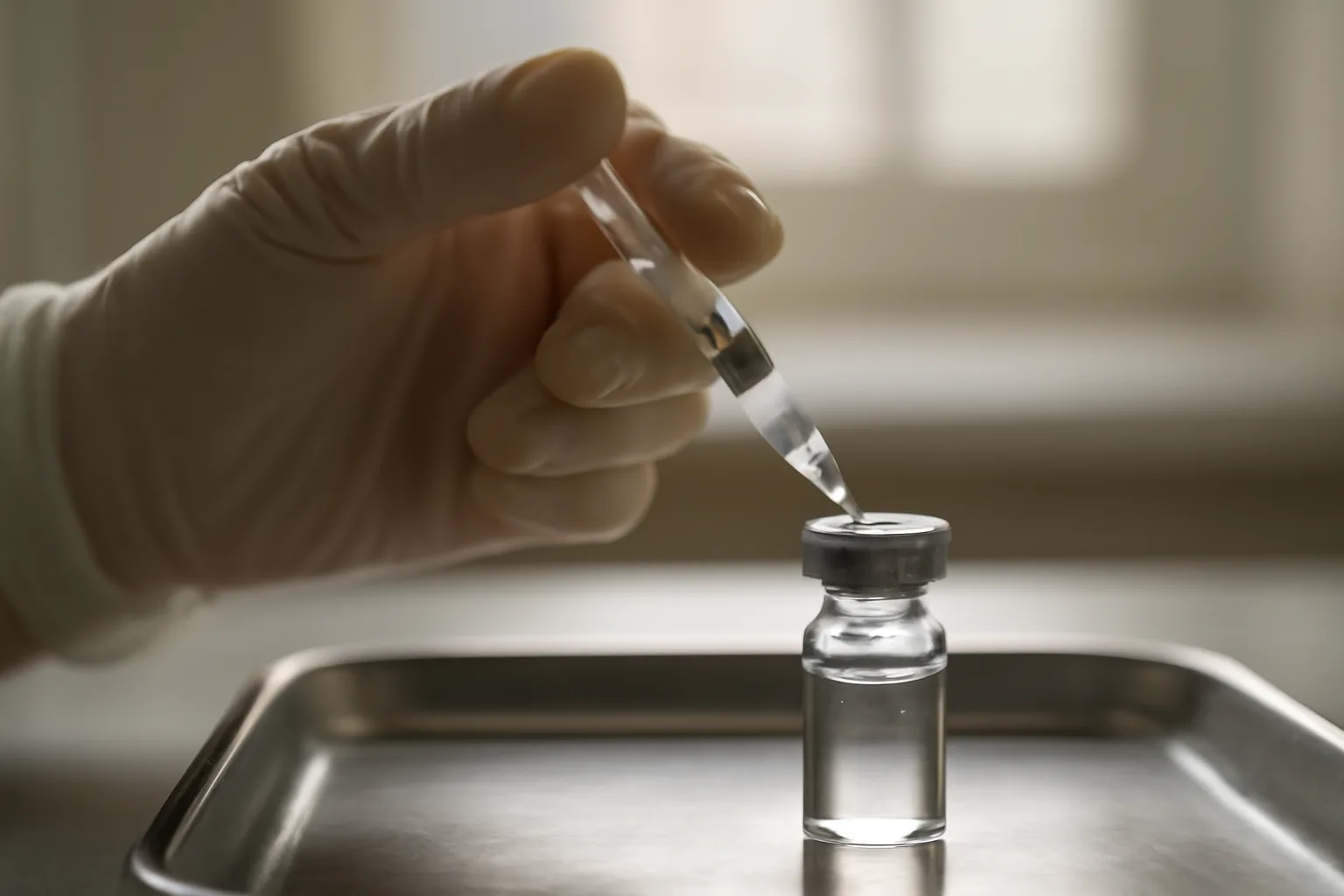
Reconstitution just means turning freeze-dried peptide powder back into a liquid you can measure and inject. CJC-1295 ships as a lyophilized (freeze-dried) powder in a sealed glass vial because peptides in liquid form degrade fast, even refrigerated. Adding a sterile liquid, almost always bacteriostatic water, dissolves the powder into a solution at a known concentration, so a research user can draw an exact volume on an insulin syringe. The process itself is simple mechanically. The part people get wrong is the math. Bacteriostatic water contains 0.9% benzyl alcohol as a preservative, which is why it extends usable vial life compared to plain sterile water [1]. Plain sterile water has no preservative and should be used within 24 hours if you use it at all. None of this is FDA-reviewed guidance for human dosing. CJC-1295 is not an FDA-approved drug; it's typically sold labeled 'for research use only, not for human consumption,' and the reconstitution steps below reflect standard peptide-handling practice used in labs, not a cleared medical protocol [2].
What supplies do you need before you start?
You need six things, and skipping any of them is where people run into contamination or dosing errors: bacteriostatic water (30 mL vials are standard), the CJC-1295 vial itself, alcohol swabs, a mixing syringe (a 3 mL syringe with a draw-up needle works well for adding water), insulin syringes for the actual injections (typically 0.5 mL or 1 mL, 29-31 gauge), and a sharps container. Work on a clean, flat surface and wipe down the tops of both vials with an alcohol swab before you touch them with a needle. Let the alcohol dry for a few seconds; injecting through wet alcohol can push it into the vial. Wash your hands first. This sounds excessive for a research compound. But the failure mode, a contaminated multi-use vial you're drawing from for weeks, is exactly the kind of thing that turns a benign process into a real problem.
How much bacteriostatic water should you add to CJC-1295?
| 2 mg | 2 mL | 1,000 mcg/mL | 10 units | 30 units | |
|---|---|---|---|---|---|
| 2 mg | 1 mL | 2,000 mcg/mL | 5 units | 15 units | |
| 5 mg | 2 mL | 2,500 mcg/mL | 4 units | 12 units | |
| 5 mg | 3 mL | 1,667 mcg/mL | 6 units | 18 units | If you want a tool that does this math for you against your specific vial size and target dose, use the cjc-1295 dac dosage calculator rather than eyeballing it. Getting the concentration wrong is the single most common mistake in self-directed peptide research, and it compounds every time you draw a dose. |
There's no single right answer; it depends on what concentration you want and how you plan to dose. Most CJC-1295 vials come in 2 mg or 5 mg sizes. A common approach is to add enough water to land on a concentration that maps cleanly onto insulin syringe markings. For a 2 mg vial, adding 2 mL of bacteriostatic water gives you 1 mg/mL, meaning 10 units on an insulin syringe (which is marked in 100 units per mL) equals 100 mcg. For a 5 mg vial, adding 2 mL gives roughly 2.5 mg/mL, so 10 units equals about 250 mcg. Here's a quick reference table for common setups: | Vial size | Water added | Concentration | 100 mcg = | 300 mcg = |
What is the correct technique for mixing it?
Draw the bacteriostatic water into your mixing syringe, then insert the needle through the rubber stopper of the CJC-1295 vial at a slight angle, aiming for the glass wall rather than straight down onto the powder. Let the water run down the side of the glass slowly. This matters more than most guides admit. Freeze-dried peptide is a fragile physical structure, and a hard stream of liquid hitting it directly can shear the peptide bonds and reduce potency. Once the water is in, do not shake the vial. Swirl it gently, or just let it sit at room temperature for a few minutes and swirl occasionally until it's fully clear. Shaking creates mechanical stress and can denature the peptide, and you'll sometimes see it turn cloudy or foam, which is a bad sign either way. A properly reconstituted vial should look completely clear, like water, with no floating particles, cloudiness, or discoloration. If it stays cloudy after 10-15 minutes of gentle swirling, something is off, either the water, the vial, or the peptide itself, and that vial shouldn't be used.
How should reconstituted CJC-1295 be stored?
Refrigerate it immediately after mixing, at roughly 36-46°F (2-8°C), and keep it out of light. Peptide manufacturers and compounding references consistently point to refrigeration as the standard storage condition for reconstituted peptide solutions, with the benzyl alcohol in bacteriostatic water helping suppress microbial growth across repeated needle entries into the same vial [1]. Do not freeze a reconstituted vial. Freezing and thawing liquid peptide solution damages the molecular structure through ice crystal formation, which is a different failure mode from just slow potency decay. Unreconstituted, lyophilized CJC-1295 is much more stable and can typically be stored refrigerated or even frozen for extended periods before mixing, which is why it ships and stores as a powder in the first place. Once it's liquid, the clock starts running.
How long does reconstituted CJC-1295 last?
Most peptide vendors and compounding pharmacy references suggest a mixed CJC-1295 vial holds its potency for about 20 to 30 days refrigerated, though this is a general peptide-handling estimate rather than a number from a CJC-1295-specific stability study. Some users push to 45 days; that's a judgment call, not a guarantee, and potency likely degrades gradually rather than falling off a cliff on day 31. This is one of the real practical differences in the CJC-1295 with DAC versus no-DAC conversation. The DAC (Drug Affinity Complex) modification binds the peptide to serum albumin once injected, which is what gives it its long circulating half-life of roughly 6-8 days in the body [3]. That's a separate property from vial shelf life after reconstitution, but in practice, no-DAC CJC-1295 (sometimes labeled CJC-1295 without DAC, or confusingly sold as 'Mod GRF 1-29') is generally considered less chemically stable in solution and is often used within 2-3 weeks of mixing, with some researchers cycling vials faster than they would with DAC versions. Write the reconstitution date on the vial with a marker as soon as you mix it. It's a small habit that prevents you from guessing later.
CJC-1295 with DAC vs without DAC: does the reconstitution process differ?
The mixing steps are identical for both versions: bacteriostatic water, slow addition down the vial wall, gentle swirl, refrigerate. Where they differ is in what the resulting solution is used for and how forgiving it is. CJC-1295 with DAC has a long half-life (again, around 6-8 days, versus roughly 30 minutes for the unmodified GHRH(1-29) peptide) [3], which historically made it attractive as a less-frequent-injection option in research settings, sometimes dosed weekly. No-DAC CJC-1295 clears fast, on the order of minutes to a couple of hours, which is why it's typically paired with more frequent dosing schedules and is the version almost universally used alongside ipamorelin, since the research rationale there depends on a sharp, pulsatile GH release rather than a sustained elevation. Neither version is FDA-approved, and there is no human clinical trial establishing a standard therapeutic dose for either form; what exists is a mix of the original peptide pharmacology papers from the 2000s [4] and a large amount of anecdotal forum-derived dosing that isn't clinical evidence. For an overview of what's actually been studied versus what's assumed, see the main CJC-1295 reference page and CJC-1295 dosage for how researchers typically structure schedules for each version.
Why is CJC-1295 usually reconstituted alongside ipamorelin?
CJC-1295 and ipamorelin target two different receptors that both feed into growth hormone release, which is the pharmacological rationale for pairing them, not a marketing claim. CJC-1295 is a GHRH analogue, meaning it mimics growth hormone releasing hormone and acts on the GHRH receptor in the pituitary. Ipamorelin is a ghrelin receptor agonist (a growth hormone secretagogue) that works through a separate pathway. Early pharmacology work on combining a GHRH analogue with a ghrelin-mimetic secretagogue found the combination produced greater GH release than either compound alone in some experimental settings, which is the basis researchers cite for using them together [5]. That is a mechanistic and early pharmacodynamic finding, not a large randomized clinical trial in humans establishing long-term safety or outcomes for this specific combination at the doses commonly used in research or self-directed contexts. Mechanically, they can be reconstituted separately or, in some protocols, combined into the same vial once each is individually mixed with bacteriostatic water, since both are commonly formulated at compatible pH and neither requires anything unusual for solubility. If you combine them, mix each with its own water first, confirm both are fully clear, then combine. Don't try to co-dissolve two powders in one shot. Keep dosing math for each compound separate even if they end up in the same syringe, since ipamorelin and CJC-1295 typically use different mcg targets.
What are common mistakes people make reconstituting CJC-1295?
Shaking the vial is the most frequent one; it feels intuitive because that's how you'd mix a drink, but it's the wrong instinct for a peptide and can degrade potency before you've injected a single dose. Using the wrong water is second. Bacteriostatic water is not the same as bacteriostatic saline, and neither is the same as plain sterile water for injection; using tap water, distilled water from a store, or anything not labeled sterile and pharmaceutical-grade introduces contamination risk into a vial you'll be drawing from repeatedly over weeks. Miscalculating concentration is third, and it's the costliest mistake because it doesn't show up as an obvious visual problem. The vial still looks clear and normal, you just dose wrong every single time until you catch it. Always write the final concentration (mcg/mL) on the vial label immediately after mixing. Fourth: reusing needles across multiple draws from a multi-dose vial. Each puncture through the rubber stopper with a used needle raises contamination risk and can also blunt the needle, causing you to core small pieces of rubber stopper into the solution. Use a fresh sterile needle each time you draw, even from the same vial. Fifth: not refrigerating immediately, or leaving the vial out at room temperature for extended stretches between doses. Room temperature storage measurably shortens usable vial life.
How do you know if reconstituted CJC-1295 has gone bad?
Visual cues are the first check: cloudiness, visible particles, or any color change from clear to yellow or amber suggest degradation or contamination, and the vial should be discarded. A clear solution isn't a guarantee of full potency, but a cloudy or discolored one is a reliable stop sign. The less obvious sign is a drop in perceived effect over time within a single vial, which some researchers use as an informal signal that potency is fading even without visible changes, though this is subjective and not something you can verify without lab testing. If you're past the general 20-30 day window and unsure, the conservative move is to discard and reconstitute a fresh vial rather than guess. Smell isn't a reliable indicator for peptides the way it might be for some biologics. Don't rely on it.
Where should you source CJC-1295 if you want a reconstitution-ready product?
Sourcing matters more for CJC-1295 than for almost any other step in this process, because reconstitution technique can't fix a vial that was never accurately dosed, properly lyophilized, or handled under cold chain in the first place. A powder that arrived warm in transit, or that was compounded with poor quality control, can look and mix identically to a good one while being significantly under- or over-potent. Look for vendors that provide a certificate of analysis (COA) from third-party testing showing actual peptide content and purity, more than a label claim. For a rundown of what to check when comparing suppliers, see CJC-1295 for sale. If you want a provider-reviewed path where sourcing and pharmacy fulfillment have already been vetted, CJC-1295 Co reviews providers and points to a fulfilling pharmacy partner for that route, which removes most of the guesswork in the sourcing step, though CJC-1295 Co does not compound or manufacture any product itself.
What safety precautions matter most during reconstitution?
Sterile technique is the whole game. Swab every vial top before each needle entry, never touch the needle tip to anything, and don't recap needles by hand if you can avoid it (or use the one-handed scoop technique if you must recap). Discard any vial where the stopper seal looks compromised on arrival, or where the powder looks anything other than a uniform, dry cake. A powder that looks caked unevenly, discolored, or shows visible moisture before you've added anything suggests a storage or shipping failure upstream. Beyond the mixing process itself, injection-site reactions, headache, water retention, and flushing are the most commonly reported effects with CJC-1295 use; a full rundown of what's reported and how often is covered on CJC-1295 side effects. None of that is specific to reconstitution error, but poor sterile technique during mixing is one of the more preventable contributors to injection-site problems specifically.
Frequently asked questions
How much bacteriostatic water do you mix with 2mg of CJC-1295?
A common ratio is 2 mL of bacteriostatic water per 2 mg vial, giving a concentration of 1,000 mcg/mL, or 10 units on an insulin syringe per 100 mcg. Some researchers use 1 mL for a more concentrated 2,000 mcg/mL solution. Either works; pick whichever maps most cleanly onto your intended per-dose amount.
Can you use regular water instead of bacteriostatic water?
No. Regular tap or distilled water is not sterile and contains no preservative, so it introduces contamination risk and forces you to discard the vial within about 24 hours. Bacteriostatic water contains 0.9% benzyl alcohol as a preservative, which is what allows a mixed vial to be used safely over multiple weeks [1].
Should you shake the vial to mix CJC-1295?
No, never shake it. Shaking creates mechanical stress that can denature or shear the peptide, reducing potency. Add the water slowly down the vial wall and swirl gently until the solution is clear, letting it sit at room temperature for a few minutes if needed.
How long does reconstituted CJC-1295 last in the fridge?
Most peptide-handling guidance points to roughly 20-30 days of usable potency once refrigerated at 36-46°F, though this is a general estimate rather than a compound-specific stability study for CJC-1295. Write the mix date on the vial and don't push much past that window.
Does CJC-1295 need to be refrigerated after mixing?
Yes, immediately. Reconstituted peptide should go straight into the refrigerator at 36-46°F (2-8°C) and stay there between doses. Never freeze a mixed vial, since freeze-thaw cycles damage the peptide structure through ice crystal formation, a different and worse failure mode than gradual potency loss.
What's the difference between CJC-1295 with DAC and without DAC for dosing purposes?
CJC-1295 with DAC has a long half-life of roughly 6-8 days due to albumin binding, historically supporting less frequent dosing [3]. No-DAC CJC-1295 clears within minutes to a couple hours and is dosed more frequently, almost always alongside ipamorelin for a pulsatile GH-release rationale. Reconstitution steps are the same for both.
Why is CJC-1295 usually paired with ipamorelin?
CJC-1295 is a GHRH analogue and ipamorelin is a ghrelin receptor agonist, so they act on separate receptors that both influence GH release. Early pharmacology research found combining a GHRH analogue with a ghrelin-mimetic produced greater GH output than either alone in experimental settings [5], though this isn't confirmed by large human trials at typical research doses.
How do you know if your CJC-1295 vial has gone bad?
Check for cloudiness, visible particles, or a color shift from clear to yellow. Any of those means discard it. A clear appearance doesn't guarantee full potency past the typical 20-30 day usable window, but cloudiness or discoloration is a reliable sign the vial should not be used.
What size needle should you use to reconstitute and inject CJC-1295?
Use a standard 3 mL syringe with a draw-up needle to add the bacteriostatic water to the vial. For the actual injection, insulin syringes in the 29-31 gauge range, typically 0.5 mL or 1 mL, are standard for the small subcutaneous volumes involved.
Can you mix CJC-1295 and ipamorelin in the same vial?
Some researchers combine them after reconstituting each separately with its own bacteriostatic water, confirming both solutions are clear before combining. Keep the mcg dosing math for each compound tracked separately even when they're drawn from the same combined vial, since typical per-dose amounts differ between the two peptides.
Is CJC-1295 FDA-approved for reconstitution and human use?
No. CJC-1295 is not an FDA-approved drug and is typically sold labeled for research use only [2]. The reconstitution steps described in this article reflect standard peptide-handling practice used in research and compounding contexts, not an FDA-cleared medical protocol, and no standardized human dose has been established by regulatory review.
What happens if you inject a peptide that wasn't reconstituted correctly?
Under-mixed or improperly handled peptide may deliver inconsistent or reduced doses, while contamination from poor sterile technique raises infection risk at the injection site. Neither is likely to be immediately obvious, which is why concentration math, clear/particle-free appearance, and consistent sterile technique all matter more than they might seem to for a simple mixing step.
Sources
- DailyMed, Bacteriostatic Water for Injection label: Bacteriostatic water contains 0.9% benzyl alcohol as a preservative
- FDA, Compounding and the FDA: Questions and Answers: Research-use peptides like CJC-1295 are not FDA-approved drugs
- PubMed, Teichman et al., 2006, prolonged growth hormone response to CJC-1295 (PMID 16352683): CJC-1295 with DAC has a prolonged half-life of approximately 6-8 days versus unmodified GHRH
- DrugBank, CJC-1295 pharmacology record (DB05801): Original pharmacology data establishing CJC-1295's mechanism and albumin-binding half-life extension
- PubMed, Ghigo et al., growth hormone-releasing peptide combined with GHRH increases GH release (PMID 10999826): Combining a GHRH analogue with a ghrelin receptor agonist produces greater GH release than either compound alone in experimental settings
- U.S. Pharmacopeia General Chapter 797, Pharmaceutical Compounding: Sterile Preparations: Standards for sterile technique and multi-dose vial handling that underlie recommended reconstitution practice