 Plays from YouTube when you click
Nick Norwitz MD PhD · October 5, 2026 · 23:16 · 215,920 views
Lose fat and gain muscle together? A physician's video: the main claim
Losing fat while gaining muscle is possible, and a ladder of tools, from sleep, lifting and protein up to injectable growth hormone peptides, makes it easier.
Verdict: the lifestyle half of this video is sound coaching, and the peptide half is a pitch resting on animal data and anecdote. For CJC-1295, the one drug in it that I could check, the human record is about three papers from 2006 to 2009 in healthy adults, and none of them measured muscle or fat.
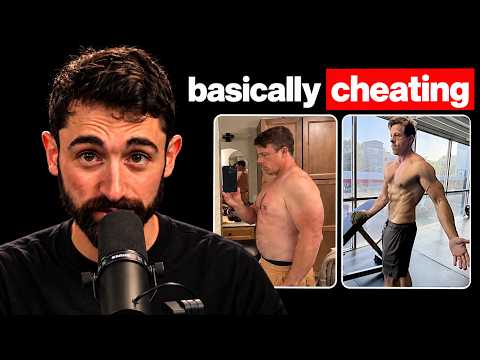
Nick Norwitz opens with a patient who lost 50% of his body fat and gained 15.6 lb of muscle, and says no steroids or illicit compounds were needed. The drug list arrives later: testosterone replacement, tirzepatide, a low-carb diet, lifting and about 10,000 steps a day. By then the muscle gain has grown to 26 lb. That is one uncontrolled case, and the drugs on the list explain it better than any peptide does.
The growth hormone peptide segment is where the video drifts. The mechanism is described accurately. Then comes a personal report of 10 lbs of muscle gained over a few months, photos from the CEO of the clinic he recommends, and a hope that such results become the norm. Nothing in our evidence file supports that outcome for this drug. The tesamorelin figures and the other compounds sit outside the fact sheet I used, so I have not graded them.
Lose fat and gain muscle together? A physician's video: what holds up
- Describes CJC-1295 as a growth hormone releasing hormone analog that amplifies the body's own signal and is not growth hormone itself. The human trials fit: in healthy adults a single injection raised GH 2- to 10-fold and IGF-I 1.5- to 3-fold (2006 placebo-controlled trials). Those were hormone levels only, with no clinical outcome. Source
- Says tesamorelin is an FDA-approved tool for specific populations only. A 2026 sports medicine review agrees that it is approved for HIV-associated lipodystrophy, and it is the approved comparator, while CJC-1295 is not described as approved. Source
- Declines to give a dosing schedule for the peptides. That is the right call here, because no trial tested CJC-1295 for muscle or fat, so no schedule for those goals has trial support.
- Says plainly that 5-amino-1MQ has no randomized human trial and that the mouse results may not carry over to people. He names the species for the animal results throughout the video. I did not check those mouse figures, since our fact sheet covers CJC-1295 only.
- The opening section on sleep, lifting and protein is conventional advice, framed honestly as a foundation with a natural ceiling. It sits outside the evidence file, and nothing in it conflicts with the file.
Lose fat and gain muscle together? A physician's video: what it skips or gets wrong
- Calls the peptide combination a prescription compound that needs physician oversight when obtained properly. No approval or label for CJC-1295 appears in the records. Reviews call it investigational and accessible through unregulated markets, and report mislabeled or contaminated products. Source
- Says the peptide encourages larger but still physiologic pulses. In 2006 healthy men, pulse frequency and size were unchanged after one injection, but trough GH rose 7.5-fold, mean GH 46% and IGF-I 45% at one week. The overall pattern changed, and the number of men is not stated. Source
- Never says which form of CJC-1295 he means. The human trials used the long-acting albumin-binding form, with an estimated half-life of 5.8 to 8.1 days. Ipamorelin, its usual partner, has a half-life of about 2 hours in healthy men. No human data exist on the combination, or on the form without the long-acting group. Source
- Muscle gain and fat loss with these peptides is presented through personal observation and a clinic CEO's photos. No human trial of body composition is in the records. A review mentions improved muscle tension in mice given CJC-1295 with ipamorelin and says the findings are limited to animals. Source
- Lists side effects for the myostatin therapy but none for the peptides. The short trials reported no serious adverse reactions, yet reviews of the class list prolactin and cortisol elevations, dysglycaemia, fluid retention, joint and muscle pain and injection-site reactions. Long-term safety is unstudied, and the one registered phase 2 trial of CJC 1295 (120 enrolled, HIV visceral fat) was terminated with no results posted. Anyone subject to drug testing should know it is on the WADA prohibited list. Source
- The cold open stacks a human case with the line that 100% of the weight loss came from fat. That figure comes from a mouse study of a different compound. The patient's muscle gain is also given as 15.6 lb early on and 26 lb later, and neither number is sourced.
Lose fat and gain muscle together? A physician's video: strengths and weak spots
Strengths
- Frames sleep, lifting and protein as the base before any injectable comes up.
- Says in plain words that one compound has no randomized human trial.
- Gives no dosing schedule for the peptides and says he is not urging viewers to try everything.
- Explains the growth hormone releasing hormone mechanism clearly enough for a beginner.
Weak spots
- The hero case rests on testosterone replacement plus tirzepatide, and the drug list comes only after a no-steroids opening.
- The patient's muscle gain changes from 15.6 lb to 26 lb with no explanation.
- Calls CJC-1295 a prescription compound, though no approval appears in the records.
- Gives no side effects or doping status for the peptides, while links for other compounds sit in the description.
Lose fat and gain muscle together? A physician's video: our recommendation
Skim. The opening section on lifestyle basics and the mouse segments, which he labels as animal work, are fair. Treat the CJC-1295 segment as a pitch, not evidence. Read the PubMed abstracts for the two 2006 healthy-volunteer trials (PMID 16352683 and 17018654) to see what was measured, and ask a clinician about the doping status and product quality questions before considering any injectable.